Tag Archives: Ohio

Speaking is a Privilege: Dystonia Awareness and AAC Advocacy in the Disability Community in Ohio.

September is Dystonia Awareness Month. As a person living with Dystonia I find it difficult to exist in many of my advocacy circles on the state level in Ohio.

It seems as though my National Advocacy groups accept me as I am but in Ohio it is lot different.

I thought a blog might help raise awareness and shine light on the fact that there are people use (AAC) Augmentative Alternative Communication to communicate intermittently and how we should be more inclusive as a community.

When someone uses a communication device it takes time to communicate and people should be given time to be heard thru their communication device.

When someone speaks but also uses AAC people should just respect them regardless of if they speak or use an assisted technology to communicate.

Ohio advocacy spaces aren’t truly inclusive. I find myself in a daily struggle whether to log on an advocacy group or to just skip a group because of lack of understanding. It is a privilege to speak. Often there are things people take for granted. We often don’t wait and give people time to speak. There is a lot ableism and lack of understanding about disability challenges that people face and especially for those who have speech or language based disabilities. It is difficult to be heard when someone’s speech might be great one day and the next it isn’t great.

This past week I found that some people don’t even know what AAC is. If you don’t use your voice in normal way people just don’t hear you. It is a struggle to be included.

I believe when people have the right tools and supports they can communicate and be active in their communities. That participation sometimes is affected by the communities that exist understanding and making way for a different way to communicate.

We advocate for technology and Ohio is a technology first state in promoting independence. At the same time, how many people do you meet in your advocacy groups who are actively using technology to help them speak or be heard in an advocacy space?

In my situation, people are also used to my strong advocacy voice that they don’t even recognize my computer generated voice even though I am the same person with same message. On days where my disability affects me more I am excluded.

My disabilities aren’t obvious. I have Autism I also have Dystonia a very complicated disability and the symptoms when I am In a full blown attack look like I am having a stroke. People have actually mistaken me in those moments. I have used AAC to advocate for my needs. I have had to fight to also keep my day going. Things people don’t realize. This being my day is not cancelled when I use my AAC to communicate.

Dystonia is a neurological condition that causes involuntary, uncontrolled muscle contractions/ movements.

This can result in repetitive twisting motions, tremors, and unusual, often painful, body postures. It affects speech and sometimes choking and vision issues. These symptoms happen because of bad signals from the brain, which affects how muscles are supposed to move.

These symptoms can happen at any time and I use AAC as my back up default way to communicate.

I have been patient but often my silence is just this mindset if you don’t speak up then you must not have anything to say.

I have a lot to say. Often it gets missed. My AAC device can help me send texts or copy text and paste to a chats on zoom or teams. I sometimes type in the chat to participate when I can type. My active voice in communities is often not there unless I raise my hand and try push my self to speak. The pause sometimes makes people uncomfortable or they think I am not there or they think the connection is bad. I want to be heard when I use my AAC too. I need time to push a button takes literally seconds. I don’t raise my hand until I can generate my communication to help people. Still then that 3 seconds of silence usually makes people move on.

It would be helpful if people recognize that there are AAC users among them that the 3 second pause is necessary for communication.

Not everyday is the same. My AAC device is my voice it is way of communicating when I don’t have physical words.

September is Dystonia Awareness Month. I chose to raise awareness to change outcomes in hopes my advocacy spaces will be more inclusive and accessible to me.

If you want to read more about Dystonia check out these resources

Cleveland Clinic

Dystonia Medical Research Foundation

National Organization on Rare Diseases

This is the only plain language resource I could locate from Care Pathways on Dystonia so much information out there but not very much in plain language.

All around Dystonia is treatable and for me 40 years of symptoms and I am finally on right pathway for treatment. Finding spaces that are going to be accessible for me to be included when my symptoms are intense is problem.

We should want to be a community welcomes anyone with any disability and in anyway that anyone communicates.

Being able to speak is a privilege that many people take for granted. Losing my ability to speak with my own voice has been a lot of struggle and the need to be included is important to me.

As someone who is a national advocate, I want to be included in state wide advocacy too. #EveryoneCommunicates and as a disability community we should be willing to learn about other disabilities and ways people communicate to make space for more people to be at the table.

To the person reading this who uses AAC all the time your voice is valuable at the tables of advocacy . Just as I don’t plan to stop communicating please don’t stop. Everyone has a seat in advocacy just Ohio must be more open to being a space that makes room for anyone to communicate and speak up!

OHID what is it and why is it important?

OHID is the online portal for accessing all of Ohio benefits and state agencies. OHID gives you a single, secure account to log into State of Ohio websites and services. To learn more about it and why it is important check out this link.

If you once used the online benefits portal on its own you need to listen up! The new system requires you to create an OHID account then log in and search the App Store within the portal. It requires you to link your Ohio Benefits Portal to your OHID to access the application portal for benefits such as Ohio Medicaid, SNAP, and other assistance programs.

This is critical information especially if you file or report changes for your Medicaid or SNAP interim reports or yearly renewal of benefits. Don’t lose access! Create an OHID account today and Log in today to connect these critical apps and portals so you can stay connected to your services, supports and Medicaid benefits,

The Pulse: What’s going on around Ohio September 1st 2025 to September 6th 2025

Upcoming things to sign up to get involved with or make your voice heard thru surveys and public comment!

  • Participate in Public Comment is for background check rules for employment for Ohio Developmental Disabilities Services Providers read more through this link to learn how to participate in public comment.
  • Research participants wanted for The Lurie Institute for Disability Policy.
    The study is about the sexual and reproductive health needs and experiences of young people with disabilities.
    To participate, people must:
    Have been born in the United States
    Live in the United States
    Be between 15 and 25 years old
    Have a health condition or disability, such as a vision, hearing, physical, intellectual, or developmental disability.
    Be able to talk in English, Spanish, or American Sign Language over a Zoom call
    Participants will be asked to do a 1-hour Zoom call to talk about their experiences. American Sign Language interpretation and accommodations will be provided on request.
    Why is this study important? Why should you care or share this information?
    People do not know a lot about young people with disabilities’ experiences with sexual and reproductive health.
    The study will help the researchers create a website for young people with disabilities that will teach them about taking care of their sexual and reproductive health.
    Our findings could be used to help advocate for youth with disabilities.
    Why should participants tell their story?
    They get a $50 gift card.
    Their stories will help us create a website that will teach people with disabilities about sexual health.
    Their voice will help inform and add to the little research on this important topic.
    Contact information
    Anyone who is interested can email YouthStudy@Brandeis.edu or call Janelle Mills, at 781-736-3928. More information is on our website.
  • Brandeis University is conducting a research study focused on the experiences of disabled people of color transitioning from institutions back into the community. They’re seeking staff from health plans, aging care organizations, providers, state agencies, CILs, and other support organizations to participate in a 90-minute virtual focus group.
    Participants will receive a $50 gift card. Insights will help shape future policy.
    Sign up: https://buff.ly/QMEn889
    Questions: hcbsaccess@brandeis.edu
  • Do you have an intellectual disability and identify as obese?
    We want to hear from you!
    Deakin University is running a research project about how relationships impact weight and physical activity for people with intellectual disability.
    You’ll be invited to take part in 1–2 interviews using art to help us communicate.
    You’ll receive a $50 gift voucher for taking part. Co-designed with people with intellectual disability and their supporters.
    Interested? Contact Sam Lilly: slilly@deakin.edu.au
  • The Yale Disability Research Lab is recruiting US adults (age 18 or older) who identify as Black/African American and part of the disability community to participate in a research study.
    Participants will be asked to share their experiences of racism, ableism, and other daily life challenges in an interview. This information will help them to develop a questionnaire measure which we will use to capture the experiences of Black people with disabilities.
    This questionnaire will be an important tool to help us understand how the unique lived experiences of Black people with disabilities might impact their health and well-being.
    You might be eligible to participate:
    18 years or older
    Self-identify as Black/African American with a disability
    Fluent in English
    Reliable access to the Internet and videoconferencing equipment (i.e., a computer, tablet, or smartphone with webcam and microphone)
    https://medicine.yale.edu/ycci/clinicaltrials/trial/exemption-intersectional-stigma-measure-development/
    Image Description: AAHD logo and Yale logo. Outline background image of people silhouettes in different colors with and without disabilities. Text overlaid says “Seeking Research Participants! Do you have a disability? Do you identify as Black/African American?

Events around Ohio to For September 1st -September 6th 2025

Monday September 1st 2025

  • 3rd Annual Mental Health Matters 5K 8am-9am The Rotary Club of Cambridge is hosting their 3rd annual Menthal Health Matters 5k walk/run on Monday, September 1st at the Cambridge City Park sign up for run
  • We Thrive Together History of Labor Day Event 11:00-12;00pm click this link to join.
  • Adaptive Pickleball, Tuesday, Sep 2 · 5–6:30 PM Athens Community Center, 701 E State St, Athens, OH 45701

Tuesday September 2nd 2025

  • Early Childhood Open Play, Tuesday, Sep 2 · 10:45–11:45 AM, Repeats weekly Please join us for open play time on our playground! Children birth to age 6 enrolled in WCBDD services and their parents/caregivers are welcome to attend. Siblings under age 6 may also attend. Sign up here:
  • We Thrive Together Tech Talk 11:00am-12:00pm click this link to join.
  • Breaking Silences Advocacy Committee meeting will take place on Zoom from 3-4 PM. If you’d like more information, contact Maria Matzik at:
    Maria.Matzik@acils.com
  • Neighbors in Action : A self Advocacy group out of Hamilton County meets virtually at 4pm. Click on this link to learn more.
  • SALT TALKS Topic: Transition Planning 101 6:00-7:00pm click this link to learn more.

Wednesday September 3rd 2025

  • Domestic Violence Advocacy Fundamentals (DVAF) for Seasoned Advocates, Wednesday, Sep 3 · 9:00 AM–4:00 PM (Pre Registration required) in Columbus, Ohio
  • OSDA at We Thrive Together 11:00-12:00pm click this link to join
  • Parents and Caregivers Join for a Discussion about Disability Services in Ohio. 10:00-2:00pm at Herbert Wescot Memorial Library 120 N Market street MCArthur, Ohio. To register please call 740-384-6245 extension 2107
  • Ohio Olmstead Taskforce Meets 1pm virtually please contact ohioolmstead@gmail.com for zoom link to the meeting.
  • Raising Our Kids w/ Disabilities to Lead Bright, Happy Lives, Wednesday, Sep 3 · 7:00-8:00pm at Beachwood Branch, 25501 Shaker Blvd, Beachwood, OH 44122
  • NAMI: Hearts+Minds, Wednesday, Sep 3 at 10:00 AM –
    Wednesday, Oct 1 at 11:30 AM SourcePoint, 800 Cheshire Rd, Delaware, OH 43015

Thursday September 4th 2025

  • The Alphabet Soup of SSI & SSDI Webinar Registration, Thursday, Sep 4 · 12:00-1:00 PM Virtual Workshop
    Thursday, September 4
    12:00 pm – 1:00 pm
    What’s the difference between SSDI and SSI? Can you receive both? Do you need a lawyer to apply? How does Medicare fit into the picture—and what happens when a parent retires? Navigating the world of Social Security disability benefits can feel overwhelming—but you’re not alone. Join the ASGA community for a special lunchtime session that breaks down the differences between SSI and SSDI and answers the big questions families often face:
    Does a parent’s income affect eligibility?
    What changes when a parent retires and begins collecting Social Security themselves?
    How do we ensure that benefits continue if something happens to the caregiver?
    Whether your individual is currently receiving benefits or you’re just beginning to explore your options, this session will equip you with the foundational knowledge to make informed decisions.
    WHAT TO EXPECT
    During this session, you’ll learn how to: Understand the key differences between Supplemental Security Income (SSI) and Social Security Disability Insurance (SSDI)
    Determine who qualifies for each program and how parental income and assets may impact eligibility
    Learn what happens to your child’s benefits when you retire, become disabled, or pass away
    Navigate the application process—and decide if legal assistance is necessary
    Understand how Medicare and Medicaid interact with disability benefits
    Access helpful SSA resources and starter kits for both children and adults
    WHO SHOULD ATTEND
    Parents and caregivers of individuals with disabilities
    Families preparing for future transitions, such as retirement, estate planning, or guardianship
    Anyone looking for clear, practical guidance on maintaining and protecting Social Security benefits
    DO I HAVE TO REGISTER?
    Registration is required to receive the virtual meeting link.

    QUESTIONS
    If you have questions or need additional assistance, contact Theresa Maier, ASGA Support Specialist 330-940-1441 ext 1
  • Mind/Body/Art, Thursday, Sep 4 · 6–7 PM at Cincinnati Art Museum Cincinnati, Ohio

Friday September 5th 2025

  • Little Hands Sensory Group at Perry Cook Memorial Public Library in Mt Gilead, Ohio from 10:00-11:00 am Join us for Little Hands Sensory Group, provided by the YWCA Child Care Resource and Referral Department. Little Hands Sensory Group is designed for families with children 3-10 years of age.
  • We Thrive Together Advocacy Army 4:00-5:00pm click this link to join
  • The Big Living Room 6-9pm The Big Love Living Room is a sensory-inclusive space that has soft music, seats, crafts, and healthy snacks. Sponsored by The Big Love Network, Akron’s environmental health equity organization. Kenmore Branch Library, 969 Kenmore Blvd, Akron, OH 44314

Saturday September 6th 2025

  • Blind, Deaf, and DeafBlind Accessibility Day, Saturday, Sep 6 · 8:00 -8:00 Pm Columbus Zoo and Aquarium, 4850 W Powell Rd, Powell, OH 43065
  • Empowering Epilepsy, 23500 Mercantile Rd suite d, Beachwood, OH 44122 1-3pm
  • Ability Censer Family Fun Day, Saturday, Sep 6 · 12–3 PM REGISTRATION IS OPEN!!! 🥳
    We’re thrilled to announce that registration is now open for our 4th Annual Family Fun Day! Join us on Saturday, September 6th, from noon to 3pm on our campus at 5605 Monroe Street for a fun, inclusive, and accessible event designed for the whole community.
    From FREE food and inflatables to adaptive sports, games and crafts, this beloved event is a highlight of the year. It’s highly anticipated by past attendees and is sure to create lasting memories for you and your family.
    Mark your calendars and register for FREE today:
    This event is proudly sponsored in part by the Toledo Mud Hens Helping Hens Foundation
  • Art Show for Mental Health Awareness featuring Original Artwork, Live Artists and Local Music, Saturday, Sep 6 · 4:00-8:00pm Artspace Hamilton Lofts and The Strauss Gallery, Hamilton Center, 222 High St, Hamilton, OH 45011

Helpful Information by National, State and County Agencies and Organizations for People to Read

  • CITY OF
    • CHILLICOTHE
    TRANSIT SYSTEM
    Coming September Ist
    ADA PARATRANSIT SERVICE
    In accordance with ODOT compliance and under ADA guidelines, Chillicothe Transit System is implementing Complementary ADA Paratransit Service.
    Individuals who are unable to use the fixed route service because of disability will be provided with complementary ADA paratransit service that is comparable to the fixed route service in service availability and quality. Complementary ADA paratransit service will be available Monday through Friday between the hours of 7am and 6pm.
    To obtain eligibility for the service, the passenger must submit a properly filled out ADA Paratransit Eligibility Application. Applications will be reviewed and eligibility status determined within 21 days of submission. Beginning September st
    *, 2025, in order to schedule a ride for the ADA Complementary
    Service, eligible passengers will have an ID card issued to them by CTS.
    The ADA Paratransit Policy and a fillable PDF
    ADA Paratransit Application with instructions are available at http://www.chillicotheoh.gov by navigating to the Transit page, then the ADA Paratransit menu, or scan the QR code below.
    Applications may also be picked up from the Transit Hub at 575 E. 71h St.
  • Emergency Preparedness for Individuals with Rare Diseases
  • Cuyahoga Board of Developmental Disabilities Serves Get your exercise on at an inclusive event in the community.
    Visit link to find an event in our Online Resource Guide.
  • INTRODUCING THE ‘BURG BUS
    For Reynoldsburg Residents 65+ and Individuals with Disabilities Enjoy free, door-to-door rides to your favorite spots around the city!
    Whether it’s shopping, dining, medical appointments, entertainment, parks, or places of worship – the Burg Bus will get you there safely and comfortably.
    HOW TO RIDE
    Call 833-742-7333 Opt. 1
    RIDES AVAILABLE
    Hours of operation
    M-F 9 a.m – 4 p.m.
    WHERE YOU CAN RIDE?
    Anywhere within Reynoldsburg!
    Let us take you to:
    Medical Appointments
    Grocery Stores & Shopping Centers
    Restaurants & Entertainment
    Parks & Recreation Areas
    …and more!
    Call to schedule
    M-F 8:30 a.m – 4 p.m.
    BENEFITS OF RIDING THE BURG BUS
    The rides are free.
    Vehicles are wheelchair accessible.
    Drivers are licensed professionals.
    Share rides with your friends to your favorite places around town.
    And sharing rides is good for the environment!
    ReynoIdsburg, 0H
  • News Highlight: Bridging Aging and Disability Networks (BADN) Explains How to Better Support Aging Adults with IDD and Their Caregivers
    A new article called “Bridging Aging and Disability Networks to Support Aging Adults With Intellectual and Developmental Disabilities and Family Caregivers” was published in the Public Policy and Aging Report by the Gerontological Society of America.
    The article explains that people with intellectual and developmental disabilities (IDD) are living longer, and their needs — along with those of their aging family caregivers — are getting more complicated. Most still live at home with support from aging parents or relatives. Even though they have many of the same needs as other older adults, they are often overlooked because aging and disability services don’t always work together.
    You can read the full BADN article in the latest edition of NACDD’s Insight: https://nacdd.org/nacdd-insight-july-2025/#badn
  • Resources for Improving Respite Care for Caregivers
  • Ready to get out into the workforce? Our teams will support you to find the best-fitting job!
    Cuyahoga DD’s Online Resource Guide has local job opportunities for the people we serve.
    Local jobs with openings at ow.ly/NGL050WqLmA
  • Guide to Employment for People with Disabilities 2025

September Awareness Month

  • Self Care Awareness Month
  • National Suicide Prevention Awareness Month
  • September 1st-6th is National Migraine Awareness Month
  • Childhood Cancer Awareness Month
  • September 6th is National Read a Book Day
  • National Spinal Cord Injury Awareness Month
  • National Library Card Sign Up Month

Anniversary of The Americans with Disabilities Act !

Today marks the 35th anniversary of the signing of the Americans with Disabilities Act (ADA).

This landmark legislation protects people with disabilities from discrimination in all areas of public life, including employment, education, transportation, and access to public and private spaces open to the general public. The ADA was enacted to ensure that people with disabilities enjoy the same rights and opportunities as everyone else.

Learn more about the ADA and its continued impact here: https://adata.org/learn-about-ada

Please read the ADA Proclamation put out by Ohio Governor.

In the Name and by the Authority of
THE STATE OF OHIO
WHEREAS, the Americans with Disabilities Act (ADA) was signed into law on July 26, 1990, to ensure the civil rights and equal opportunity for people with disabilities; and
WHEREAS, this year marks the 35* anniversary of the ADA; and
WHEREAS, the ADA has been instrumental in protecting people with disabilities in many areas of everyday life; and
WHEREAS, as a member of the U.S. House of Representatives, Mike DeWine had the honor of voting for this critical legislation; and
WHEREAS, about 42 million Americans have a disability, including more than 1.6 million Ohioans; and
WHEREAS, the FY 24-25 state operating budget signed by Governor Mike DeWine and supported by the Ohio Department of Developmental Disabilities and Opportunities for Ohioans with Disabilities included language to encourage more community engagement by increasing funding for universal changing tables in public places, reserving a seat on county board of developmental disabilities for people who receive services, and launching Accessible Ohio which creates the first-ever coordinated effort in Ohio to support cities, counties, state agencies, attractions, and venues to be accessible and inclusive.
WHEREAS, the ADA has expanded opportunities for Americans with disabilities by changing perceptions and increasing full participation in community life; and
WHEREAS, one of Mike DeWine’s first acts as Governor was to sign an executive order establishing Ohio as a Disability Inclusion State and Model Employer of Individuals with Disabilities; and
WHEREAS, Ohio has invested the most funds in the nation for universal changing tables in public places, reserves a seat on county boards of developmental disabilities for people who receive services, and launched Accessible Ohio which creates the first-ever coordinated effort in Ohio to support cities, counties, state agencies, attractions, and venues to be accessible and inclusive; and
NOW, THEREFORE, we, Mike DeWine and Jim Tressel, Governor and Lieutenant Governor of the State of Ohio, do hereby recognize the 35* Anniversary of
AMERICANS WITH DISABILITIES ACT
on this 11″ of July 2025;
Mike DeWine Governor

Image description
In the Name and by the Authority of
THE STATE OF OHIO
WHEREAS, the Americans with Disabilities Act (ADA) was signed into law on July 26, 1990, to ensure the civil rights and equal opportunity for people with disabilities; and
WHEREAS, this year marks the 35* anniversary of the ADA; and
WHEREAS, the ADA has been instrumental in protecting people with disabilities in many areas of everyday life; and
WHEREAS, as a member of the U.S. House of Representatives, Mike DeWine had the honor of voting for this critical legislation; and
WHEREAS, about 42 million Americans have a disability, including more than 1.6 million Ohioans; and
WHEREAS, the FY 24-25 state operating budget signed by Governor Mike DeWine and supported by the Ohio Department of Developmental Disabilities and Opportunities for Ohioans with Disabilities included language to encourage more community engagement by increasing funding for universal changing tables in public places, reserving a seat on county board of developmental disabilities for people who receive services, and launching Accessible Ohio which creates the first-ever coordinated effort in Ohio to support cities, counties, state agencies, attractions, and venues to be accessible and inclusive.
WHEREAS, the ADA has expanded opportunities for Americans with disabilities by changing perceptions and increasing full participation in community life; and
WHEREAS, one of Mike DeWine’s first acts as Governor was to sign an executive order establishing Ohio as a Disability Inclusion State and Model Employer of Individuals with Disabilities; and
WHEREAS, Ohio has invested the most funds in the nation for universal changing tables in public places, reserves a seat on county boards of developmental disabilities for people who receive services, and launched Accessible Ohio which creates the first-ever coordinated effort in Ohio to support cities, counties, state agencies, attractions, and venues to be accessible and inclusive; and
NOW, THEREFORE, we, Mike DeWine and Jim Tressel, Governor and Lieutenant Governor of the State of Ohio, do hereby recognize the 35* Anniversary of
AMERICANS WITH DISABILITIES ACT
on this 11″ of July 2025;
Mile
Mike DeWine
Governor

The Pulse: Special Edition What’s going on around Ohio June 30th to July 13th 2025!

Upcoming things to sign up to get involved with or make your voice heard thru surveys and public comment!

  • The Synergy Committee is seeking nominations for several awards that will be given out at the SYNERGY Conference in October. This is YOUR chance to nominate ANYONE who is making a difference! It is important to take the time to recognize outstanding people that go above and beyond. Who can be nominated in each of the award categories? EVERYONE! It can be an advocate, family member, person served, local partner, a provider or DSP, a county board staff person, a teacher, legislator, a community member, an employer, or anyone else who you think is deserving of one of these awards. DEADLINE FOR ALL NOMINATIONS IS JULY 31st.
    SUBMIT YOUR NOMINATION USING THE LINK BELOW:
    https://conta.cc/4jM40QK
  • Disability Rights Ohio Is doing their annual survey of needs click this link to take the survey.
  • Ohio Department of Developmental Disabilities is asking people to take a survey on self direction for waiver participants. Click on this link to do the survey.
  • The Ohio Medicaid Matters Coalition is looking for personal stories by people who could be impacted by Medicaid cuts if this is you please check out this link to learn how to submit your story. https://www.ohiomedicaidmatters.org
  • The Ohio State University (OSU) Nisonger Center is doing research on the health, mental health, and wellness of adults with intellectual disability (ID). We need to learn more so that we can improve services.
    This study includes online interviews with adults with ID and their chosen study partners. The study should take about 3 hours. For doing the study, each participant and their study partner will each receive $100.
    To SIGN UP: Call 1-833-678-7782
  • 2025 Disability/Deaf and Abuse Survey
    This national survey seeks to enhance our understanding of the prevalence of abuse— including sexual abuse, physical assault, coercion, harassment, and exploitation—among individuals with disabilities, as well as those who are Deaf, Hard of Hearing, or Deaf-Blind.
    Your experience matters. The findings will help us develop research, interventions, and policy recommendations to advocate for strengthening protections against abuse and improving support for survivors. Click this link to take the survey.
  • Make your Voice Heard to share in a survey feedback about the PCA Match app through Public Consulting Group.
  • 5 Minutes. 3 Actions. 1 Voice for Disability Rights.
    Speak Up Now: Protect Disability Access Rights!
    https://nacdd.org/5-minutes-3-actions-1-voice-for-disability-rights/
    There are TWO public comment opportunities that need the attention of the disability community.
    🌟 Public Comment One: Protect Disability Access Rights! – The U.S. Department of Energy is trying to eliminate important disability protections. The department is trying to change part of Section 504 of the Rehabilitation Act that ensures new buildings are accessible to people with disabilities. This move could set a dangerous precedent. If they succeed, other federal agencies might try to do the same. This will weaken protections that millions rely on.
    🌟 Public Comment Two: Direct final rule on nondiscrimination – The U.S. Department of Energy (DOE) wants to remove 12 civil rights rules. Part of these 12 are disability access protections. They say the rules are “unnecessary,” “outdated,” or not supported by law. They are using a fast-track process called a “direct final rule.”
    This is urgent! If thousands do not make comments, the rule will take effect July 15, 2025.
    The deadline to submit your comment(s) is Monday, June 16th at 11:59 PM EDT.
    Take Action Now!
    It only takes a few seconds: https://nacdd.org/5-minutes-3-actions-1-voice-for-disability-rights/

Events around Ohio to check out week of June 30th 2025 to July 13th 2025

Monday June 30th 2025

  • DODD Announces Keeping Families Together: Stories of Family Resiliency Webinar, Monday, Jun 30th 12:00pm-1:00pm DODD Announces Keeping Families Together: Stories of Family Resiliency Webinar 
    Attention: County Boards, Councils of Government, Systems of Care Partners
    Learn more about how Governor DeWine’s ‘Keeping Families Together’ (KFT) initiative has impacted communities across Ohio through innovative solutions. Join DODD virtually on June 30 at noon to hear from local leadership and their creative partnerships with DODD. 

    Join the Teams meeting 
    Meeting ID: 239 306 445 048 0 
    Passcode: SU2Kv9Bg 

    Dial in by phone 
    +1 614-721-2972,,646450878# 
    Phone conference ID: 646 450 878# 

    Join on a video conferencing device
    Tenant key: 682042763@t.plcm.vc
    Video ID: 111 212 697 1
  • Mental Health Round Table 4:00-6:00pm 611 Walnut St
    Martins Ferry, OH 43935, USA

Tuesday June 1 2025

  • Disability Pride Flag Raising, Tuesday, Jul 1 · 11:00 AM–12:00 PM Join the City of Cincinnati as we proudly kick off Disability Pride Month with the Disability Pride Flag Raising Ceremony on Tuesday, July 1, 2025, from 11:00 a.m. to 12:00 p.m. at Cincinnati City Hall (801 Plum Street, Cincinnati, OH
  • Breaking Silences Advocacy Meeting 3pm contact Maria.Matzik@acils.com for more information.
  • Neighbors in Action a group for people with disabilities in Hamilton County, Ohio will meet 4:00-5:00 pm they have a special guest Alex Lomicka from Ohio Association of County Boards of DD click this link to join the meeting.

Wednesday July 2 2025

  • OSDA at We Thrive Together 11am https://wethrivetogether.org/upcoming-event
  • Time2Thrive, Wednesday, Jun 25 · 12:30–2:30 PM, Repeats every week, until Wednesday, Aug 6 FREE! Summer education enrichment for ages 13-16; Developed and led by an Intervention Specialist & an Occupational Therapist, this program offers your child engaging educational activities aimed at acquiring and strengthening essential skills. Time2Thrive is designed to combat “summer learning loss” and fosters continuous development for a lifetime of learning. This program is offered on Tuesdays and Wednesdays from 12:30-2:30 pm for 8 weeks. Siblings 11 and older are welcome to attend, too. RSVP to gina@dsaneo.org
  • Synergy Accessibility Committee 1215- 1:45pm

July 3-6th

  • No Known Events

Monday July 7th 2025

  • Careers with Peers Council 6:00-7:30pm 776 N Main St
    Springboro, OH 45066, USA Join us for Careers with Peers Council at Doubleday’s in Springboro on Monday, July 7, from 6 to 7:30 p.m. for a conversation about Professionalism!
    To RSVP, contact Cheri Cummings at (513) 806-8591 or careerswithpeerscouncil@warrencountydd.org
  • Mental Health Round Table 4:00-6:00pm 130 Fair Street Barnesville, OH 43713

Tuesday July 8th 2025

  • The Basics of Advocacy, Tuesday, Jul 8 · 2:30–3:30 PM Join us and our partners at the Ohio Developmental Disabilities Council and Ohio Statewide Independent Living Council for a three part Advocacy Training Series.
    We hope to see you at one or all three! Register here⬇️
    1️⃣ – July 8 – The Basics of Advocacy: https://bit.ly/ats1basics
    2️⃣ – July 9 – The Legislative Process: https://bit.ly/ats2leg
    3️⃣ – July 16 – Engaging with Policymakers: https://bit.ly/ats3ewp
  • Celebrating the Americans with Disabilities Act (ADA): How Assistive Technology (AT) Supports Daily Life and Work, Tuesday, Jul 8 · 3:00-4:00PM DescriptionJoin the Disability Employment Technical Assistance Center (DETAC) for a special webinar in honor of the 35th anniversary of the Americans with Disabilities Act (ADA), with a focus on how technology is shaping the future of accessibility. The ADA affirms a simple but powerful principle: Individuals with disabilities who want to work should be able to work. In today’s fast-paced technology-driven world, there have been advancements made with tools to increase accessibility. At the same time, there are basic assistive technology (AT) tools that continue to be overlooked as a solution. The webinar panel from the Assistive Technology Act Technical Assistance and Training Center (AT3 Center) will focus on increasing access to and acquisition of AT tools across the lifespan. The panel will share examples of how AT is that critical bridge to helping break down barriers and provide innovative approaches for one to be more independent within the workplace and the broader community.
    Register through this link for the event.
  • SARTEC Plain Language Webinar, Tuesday, Jul 8 · 4:00-5:00pm This is a Webinar for Government and Non-Profits Agencies. Plain language writing makes your work better — and it’s more accessible for people with disabilities and English language learners. Learn the ins and outs of plain language in this webinar. Click on the link to register.
  • Disability Q*mmunity, Tuesday, Jul 8 · 6:00- 7:30 PM contact Independence Alliance for more information.

Wednesday July 9th 2025

  • Ohio Domestic Violence Network is offering a workshop called Beyond Shelter: Advancing Housing Advocacy for Survivors, Wednesday, Jul 9 · 9:30 AM–3:30 PM please click this link to learn more. There is a fee for the workshop .
  • OSDA at We Thrive Together 11am https://wethrivetogether.org/upcoming-event
  • Supported Decision Making Network of Ohio 12:00-1:30pm click this link to join the meeting
  • Time2Thrive, Wednesday, Jun 25 · 12:30–2:30 PM, Repeats every week, until Wednesday, Aug 6 FREE! Summer education enrichment for ages 13-16; Developed and led by an Intervention Specialist & an Occupational Therapist, this program offers your child engaging educational activities aimed at acquiring and strengthening essential skills. Time2Thrive is designed to combat “summer learning loss” and fosters continuous development for a lifetime of learning. This program is offered on Tuesdays and Wednesdays from 12:30-2:30 pm for 8 weeks. Siblings 11 and older are welcome to attend, too. RSVP to gina@dsaneo.org
  • The Legislative Process, Wednesday, Jul 9 · 4:00-5:00pm (See links from previous day. )
  • Mental Health Round Table 4-6pm 11:30-1:00pm 155 Clark St.
    Powhatan Point, OH 43942

Thursday July 10th 2025

  • First Annual Youth/Young Adults with Disabilities – One Day Event, Thursday, Jul 10 · 12:30–4:00pm Ritter Public Library, 5680 Liberty Ave, Vermilion, OH 44089
  • OSDA Creative Changemakers, Thursday, Jul 10 · 4:30–5:30 PM, Repeats every month on the second Thursday ts a group of peers/self-advocates who meet once a month to hang out and talk about issues facing people with disabilities in Ohio This group supported by the Ohio Self-Determination Association. Change Makers was created by and is run by people with disabilities because they wanted to extend their advocacy conversations beyond the COOL meetings. Please Contact one of the emails listed clareschloemer.osda@gmail.com
    nrichards@clearwatercog.org
    osda2011@gmail.com
  • Neurodiversity Social for Adults, Thursday, Jul 10 · 4:00 -6:00 PM 519 Wall St
    Cairo, OH 45820, USA
  • Disability Rights Peer Support Group, Thursday, Jul 10 · 6:00-7:30 PM contact Independence Alliance for more information.

Friday July 11th 20245

  • 35th Anniversary Celebration
    of the Americans with Disabilities Act, Friday, Jul 11 · 6:00-9:00pm Columbus Museum of Art
    480 E Broad St, Columbus, OH 43215, USA SAVE THE DATE
    35th Anniversary Celebration
    of the Americans with Disabilities Act Friday July 11, 2025, 6:00-9PM
    The Columbus Museum of Art,
    480 E. Broad St., Columbus 43215
    Drinks and Hors d’oeuvres
    All are welcome.
    There is no charge for attending this event,however, registration will be required.
    Keynote Speaker:
    Rebecca Cokley,
    Program Officer
    Ford Foundation’s first-ever
    U.S. Disability Rights program
    Link to full bio:

Saturday July 12th 2025

  • First Annual Disability Pride Month Picnic, Saturday, Jul 12 · 12:00pm-4:00pm Lake Shore Park
    Lakeshore Dr, Ashtabula, OH 44004, USA
  • SALUTE Storytellers Live!, Saturday, Jul 12 · 2:00- 3:00 PM The University of Toledo, 2801 Bancroft St, Toledo, OH 43606
  • You’re invited to MAKE ‘m SMILE Ohio – the BIGGEST party celebrating kids and adults with disabilities… our VIPs! – and the people who love them!
    ✅ Free fun for the whole family
    ✅ Games, characters, activities, and more
    ✅ Resources, giveaways, and smiles for days!
    📍 Location: Hartville Memorial Park (Hartville, OH)
    📅 Date: Saturday, July 12
    🕘 Time: 11 AM – 3 PM
    Don’t miss this unforgettable day of fun and resources!
    Register your VIP family today: https://nathanielshope.org/our-programs/make-m-smile/ohio/

Sunday July 13th

  • 11th Annual All Disabilities Festival, Sunday, Jul 13 · 1:00-5:00pm Columbus, Ohio check out this link to learn more.

Helpful Information by National, State and County Agencies and Organizations for People to Read

  • ⛑️ Emergency and safety preparedness saves lives – and plans must include everyone.
    For people with disabilities, children, and older adults, accessible preparedness is critical. The United States Department of Justice outlines three key phases of emergency management: preparation, response, and recovery – and all must be accessible.
    ✅ Safety plans should clearly outline procedures.
    ✅ Use multiple alert formats (visual, tactile, etc.).
    ✅ Install accessible alarms and equipment.
    ✅ Train staff in disability etiquette and safety roles.
    ✅ Ensure service animals can evacuate with their owners.
    Tools like stair-climbing wheelchairs and communication aids can make all the difference. Together, we can build a culture of preparedness that protects everyone.
    ➡️ For more info, check out the #AccessibleOhio Safety & Emergency Management resource: link
    AllAboutAccessibility #SafetyFirst
  • Are you a caregiver for an older Ohioan? Are you familiar with Adult Day services? Visit the new website http://AdultDayOhio.org to learn about how Adult Day services can support you and your loved one.
    Read: http://aging.ohio.gov/AdultDayOhio
  • Know Your Rights: Communication Disability Law
    People with a medically diagnosed communication disability can voluntarily enroll in a database linked to Ohio’s Law Enforcement Agencies Data System (LEADS). 
    This helps notify officers during traffic stops that someone in the vehicle may have difficulty communicating, promoting safer, more informed interactions. It’s free, optional, and designed to reduce misunderstandings. 
    Learn more about the Communication Disability Law and download the Communication Visor Card here.
  • 📢 Thanks to recent grants awarded to Council on Aging, our home52 Transportation service is now offering no-cost rides for medical and other purposes to disabled Hamilton County residents age 18+ who meet income guidelines.
    home52 Transportation provides door-through-door services utilizing specialized vehicles and trained providers to ensure safe rides for adults with varying needs. 🚗
    Review requirements to qualify for this grant-funded transportation and download a registration form: https://bit.ly/3FmqyJF.
    Those who aren’t eligible for grant-funded rides may pay privately. Call our coordination center to get pricing for your ride at (855) 546-6352..
  • Veterans who need nursing home care but prefer living at home can enroll in the Veterans Directed Care Program at WRAAA. This program lets veterans hire personal direct-care workers, giving them more control over their long-term care. More details here: https://bit.ly/3XcvbMT
  • Updates to the Waiting List Assessment Rule
    Attention: All County Boards, Service and Support Administrators, Councils of Governments
    The DODD Medicaid Development and Administration (MDA) division has updated the Comprehensive Guide for Waiting List Assessmentto coordinate with updates to the waiting list assessment rule (OAC 5123-9-04). These updates will be effective July 1, 2025. 
     
    MDA held webinars in May to support assessors with completing the WLA on the new assessment platform. A recording of these webinars can be found on the current and immediate needs webpage. Click hereto access the recording.
     
    For questions, please email WLA@dodd.ohio.gov
  • Ohio has announced its 2025 sales tax holiday, which will run for two weeks this year. https://nbc4i.co/43yipK1?utm_medium=social&utm_source=facebook_NBC4
  • The Family Caregiver Support Program (FCSP) supports family and informal caregivers in caring for loved ones at home. You’re a family caregiver if you help care for an older relative, spouse, or loved one. For free information and referrals for in-home care, respite, adult day programs, and more, go to: https://bit.ly/3NN8Joa or give us a call at 216-586-3441.
  • The 2025 WRAAA Five-County Transportation Guide helps older adults, individuals living with disabilities, and caregivers find transportation options for individuals from Cuyahoga, Geauga, Lake, Lorain and Medina counties. Order or download free copies today through this link .
  • Here’s a video about a tool kit on supported decision making.
  • Caring for a child with complex needs is 24/7. Respite care can make a difference. 💙
    Here is a fact sheet with helpful information.
    If you need help finding respite care for your child, please reach out to us at Ohio Family to Family.
    Email: Ohiof2f@cchmc.org
    Intake Form
  • Want to Help Create Positive Change for Ohioans with Developmental Disabilities?
    Apply to Become an ODDC Council Member!
    ODDC wants members who have personal experience with DD and who understand the needs of their communities. As a Council member appointed by Ohio’s Governor, you will help plan advocacy efforts, support community programs, and work on changes that improve the lives of people with DD and their families.
    Learn more and apply here:
  • Did you know you that 24/7 medical support provided by StationMD is a covered service for Ohioans enrolled in the Individual Options, SELF, or Level One waiver?
    StationMD has provided telehealth care for the I/DD community across 22 states since 2016. Their services ensure immediate, expert care without a trip to the ER. All clinicians are trained and specialized in the nuances of working with people with I/DD, including communication differences and co-occurring conditions.
    “They are respectful and value what the person is saying, regardless of how they’re saying it,” said StationMD Account Executive Sarah Davies. “They go the extra mile.”
    Read more about StationMD and the services available in our most recent newsletter: https://bit.ly/4g5ZRqc

This Month in Awareness

  • Disability Pride Month
  • National Cleft And Craniofacial Awareness And Prevention Month
  • National Fragile X Syndrome Awareness Month
  • Sarcoma Research Awareness Month
  • National Minority Mental Health Awareness Month
  • UV. Safety Month
  • Juvenile Arthritis Awareness Month
  • Blood Cord Awareness Month
  • Healthy Vision Month
  • National Wheelchair Beautification Awareness Month


For more events check out our main website OhioAdvocacyHeartbeat.com

In the News Around Ohio

Here are some news articles related to advocacy, disabilities and events in Ohio in the last 30 days.

The Pulse: What’s going on around Ohio May 5th to May 10th 2025!

Upcoming things to sign up to get involved with or make your voice heard thru surveys and public comment!

  • The 2025 National Health And Disability Survey is out now! this is for anyone who lives with a disability or chronic health condition. If you choose, you can enter for a chance to win one of 15 $100 gift cards! Drawings will be held weekly. You can also choose to be notified when the survey is availabble next year. Take this opportunity to stake your voice heard!
    You can access the survey by clicking this link to do the survey.
    If you any questions, please reach out:
       Phone:  1 (855) 556-6328
       Email:   healthsurvey@ku.edu
  • The Ohio Department of Education and Workforce (ODEW) would like to invite you to participate in a short, 25 question survey about your involvement in your student’s education. Research suggests that parental involvement is a key predictor of positive educational outcomes. You may be eligible to participate if your child has an IEP and receives special education services. The purpose of collecting this information is to improve services for students with disabilities across Ohio. If you are eligible to participate and you enroll in the study, you will be entered in a drawing for a $50 gift card. Your chance of winning a gift card is approximately 2.0%. Please click on the link to find out more about the survey and if you are eligible.
  • Access Center for Independent Living (ACIL) is looking for people in Champaign, Clark, Preble, Miami or Montgomery Counties to fill out their Needs Assessment Survey to help them find needs of the people with disabilities in their community.
  • The Home and Community-Based Services Policy section at the Ohio Department of Medicaid is proposing to amend Ohio Administrative Code 5160-32-02 Electronic visit verification (EVV) data collection and 5160-32-03 Alternate electronic visit verification (EVV) vendor.
    These rules set forth data collection requirements for providers regarding electronic visit verification (EVV). The proposed change to these rules removes the term “agency” in describing the types of providers the rules apply to.
    View the proposed changes here. https://dam.assets.ohio.gov/image/upload/medicaid.ohio.gov/Providers/EVV/5160-32_EVV_Proposed.pdf?utm_medium=email&utm_source=govdelivery
    Submit your feedback to HCBSPolicy@medicaid.ohio.gov by May 12, 2025.

Events around Ohio to check out week of May 5th 2025 to May 10th 2025

Monday May 5th 2025

  • Join BCBDD Community Outreach Advocate, Courtney Hineman, and Family Engagement Coordinator for the Hamilton County Developmental Disabilities Services, Sean Bostic, for a University of Cincinnati Regional Autism Advisory Council 3-Part Training Series focused on supporting people with intellectual and developmental disabilities in the workplace on Monday, May 5 from 11:30 a.m. – 1:00 p.m! Register now to see Courtney speak virtually on Monday:
    UC IDD Education Center
  • We Thrive Together Relationship: Trust/Lying Discussion 3:00-4:00pm check out this link to join
  • Adulting 101: Making Friends and Staying Connected Over The Summer 5:30pm-8:30pm Link to register
    Adulting 101 Workshops are a fun way for teens and young adults to learn about and practice various life skills that are important to being an adult. This month we will be learning about staying connect with friends and family who we don’t see everyday. This event will involve working on practice conversations, getting connected to the ACTeens GroupMe, Speed Friending, making signs of affirmation and more!
    For questions, contact Jordan Slutsky, Teen Services Coordinator, at jslutsky@abilitycenter.org

Tuesday May 6th 2025

National Nurses Day!

  • Breaking Silences Advocacy Meeting 3pm contact Maria.Matzik@acils.com for more information.

Wednesday May 7th 2025

  • OSDA at We Thrive Together 11am https://wethrivetogether.org/upcoming-events
  • Ohio Olmsted Taskforce 1-3pm The Ohio Olmstead Task Force (OOTF) is a statewide grassroots coalition of Ohioans with disabilities of all ages, family members, advocates and organizations advocating for the right to live, work and participate in their communities. Formed in 2002, OOTF supports the Supreme Court decision that held unnecessary institutionalization is discrimination against people with disabilities.
    For more information or how to access meetings email ohioolmstead@gmail.com

Thursday May 8th 2025

  • OACBDD Spring Conference Please check out this link for more information on The Ohio Association of County Boards of DD Conference https://www.oacbdd.org/main/save-the-date/
  • OSDA Creative Changemakers, Thursday, May 8 · 4:30–5:30 PM, Repeats every month on the second Thursday contact clareschloemer.osda@gmail.com for more information on how to join.
  • Ohio Family to Family Information Session: Transition out of Early Intervention:
    What Families Need to Know, Thursday, May 8 · 7–8:30 PM To Register click this link

Friday May 9th 2025

  • OACBDD Spring Conference Please check out this link for more information on The Ohio Association of County Boards of DD Conference https://www.oacbdd.org/main/save-the-date/
  • Disability Rights Ohio Weekly Budget Debriefs will be from 3 to 4 PM. Disability Rights Ohio will give weekly updates on the Ohio Budget for people with disabilities and families. If you’re interested in attending, email Brittanie Maddox at:
    bmaddox@disabilityrightsohio.org

Saturday May 10th 2025

  • Ross County Sibs 10:00am – 1:00pm Register your child for our May Sibshop gathering on Saturday, May 10th at The Landrum Youth Empowerment Center. Contact krsmith@rossdd.org
  • Holmes County Developmental Disabilities Annual Spring Festival and Auction read more about it here

Helpful Information by National, State and County Agencies and Organizations for People to Read

  • Planning an accessible outdoor adventure just got easier!
    The Ohio Department of Natural Resources has launched a new Accessible Trails Guide — your go-to resource for finding parks and outdoor spaces that meet your needs.
    In the guide, you’ll find:
    ✅ Trail safety tips
    ✅ Accessible trails, fishing, boating, and Storybook Trails
    ✅ Lodges, campgrounds, cabins, inclusive playgrounds, and more!
    Start exploring today: https://ohiodnr.gov/go-and-do/outdoor/accessible-activities-facilities/accessible-trails
  • If you or a loved one is facing a mental health or addiction crisis, you’re not alone. Call, text, or chat 988 to connect with a trained specialist ready to listen and offer free, confidential support 24/7.
    988 is a direct connection to compassionate, accessible care and support for anyone experiencing mental health-related distress.
    Learn more and find easy-to-read resources: https://dodd.ohio.gov/about-us/our-programs/988+Resources
  • This was shared by Butler County Board of Developmental Disabilities Kings Island ‘s accessibility guide has changed and we want to make sure you have all the details before visiting this summer! One of the major changes is the accessibility card! Individuals will now have to get prior approval from a third-party system that requires a doctor’s note. To make sure your prepared, please take a look at the Kings Island accessibility guide: http://www.visitkingsisland.com/accessibility
  • In honor of #MentalHealthAwarenessMonth, explore DODD’s Wellness Project, a collection of resources for EVERYONE, featuring tools for mindfulness, relaxation, and mental health support. Check out the information through this link put out by Ohio Department of Developmental Disabilities.
  • Ohio Family to Family on Navigating the IEP process can be overwhelming—here is a roadmap to help you become informed.
  • The Long-Term Care Ombudsman program (LTCOP) advocates for individuals residing in nursing facilities and residential care communities, such as assisted living facilities and board and care homes. They resolve problems that impact residents’ rights, quality of life, and quality of care, and work to improve policies at the local, state, and national levels. The Long-Term Care Ombudsman program is the only federal program mandated to advocate with, and for residents of long-term care facilities. Learn more in our new fact sheet:https://theconsumervoice.org/wp-content/uploads/2025/04/Ombudsman-Fact-Sheet.pdf
  • Qualifying older adults can now apply for the 2025 edition of the Senior Farmers Market Nutrition Program!
    Learn more: https://aging.ohio.gov/sfmnp2025
    Sign up: https://portal.homegrownbenefits.com/apply/ohio

This Week in Awareness


May:
• Mental Health Awareness Month
• National Arthritis Awareness Month
• Disability Insurance Awareness Month
• ALSOS. Awareness Month
• National Stroke Awareness Month
• National Military Service Appreciation Month
• Allergy and Asthma Awareness Month
• Jewish American Heritage Month
• Better Speech–Language-Hearing Month
• Borderline Personality Disorder Awareness Month
• Brain Tumor Awareness Month
• Cystic Fibrosis Awares Month
• Public Service Recognition Week
• Guide Dog Month
• Hepatitis Awareness Month
• Lupus Awareness Month
• Pediatric Stroke Awareness Month
• Lyme Disease Awareness Month
• Mobility Awareness Month
• Older Americads Month
• Celiac Awareness Month
• Huntington’s Disease Awareness Month
• Ehler’s-Danlos Syndrome Awareness Month
• High Blood Pressure Awareness And Education Month
• Inherited Retinal Disease Genetic Sesting Month
• Health Vision Awareness Month
• Myositis Awareness Month
• National Ostioperosis Awareness And Prevention Month
• Prader-Willi Syndrome Awareness Month
• Neurofabromotis Awareness Month
• Williams Syndrome Awareness Month

For more events check out our main website OhioAdvocacyHeartbeat.com

Building a Supported Decision Making Team by Alicia

Supported Decision Making has become a big topic in Ohio recently. Some people are curious about it and are asking what is it and how can it help people with disabilities? Some people have seen that it is an alternative to guardianship and have also wondered how it can help someone.

Supported Decision Making is something that empowers people with disabilities to make their own decisions and choices in life with the support of others. It is a way for people with disabilities to make informed decisions while understanding the pros and cons of a decision or different perspectives. It allows a person to make the best choice possible. This allows for person centered planning and involvement in directing a persons own care.

Here are a few resources to help you understand What Supported Decision Making is and isn’t.

Supported Decision Making has been super important to be able to self direction my care. I have a Supported Decision Making Team. Anyone can have people help them make decisions. I am sure that a lot of people are already using this tool without knowing it.

Sometimes people will poll their friends or consult family or others to help them decide common every day matters like what kind of car they should buy or even maybe a family dinner that is being planned.

Ultimately the person buying car decides the final final product. This is the same for people who use supported decision making ultimately they decide the choices for their life.

In April of 2024, I started my Supported Decision Making Team. When it came to choosing my team , I wanted to have a variety of people. It was important for me to build a team verses have one single person because of high complexity of my disabilities and needs. It is important to know you can chose just one person. It doesn’t need to be a team of people like I chose to do.

Some things that I took into consideration was my needs and the background of friends and others I knew in my community. My Supportive Decision Making team is diverse. It is important to know that people who support you do not have to live in the same community or even the same state as you do.

My Supportive Decision Making team meets on Zoom. I have people on my team who live in other parts of Ohio and also someone who lives in another state.

When I chose my team I thought about needing a person that was disabled, a person understood my home care services, someone was an ally but understood complex medical needs and rare diseases and someone who had nursing background. It was important for me to chose people who were my friends for a long time and people who have known me a short time.

At first the people I approached didn’t feel qualified for such an under taking what they didn’t know was they had all the qualifications I needed. The most important thing to me was finding people who would listen and then share their wisdom but ultimately let me decide.

I am a complex person and I am not afraid to admit it. I got a lot of rare diseases and also some more difficult things that I need support on than others.

Sometimes people see me as a strong advocate and they often miss my more intense needs for support. Building my team was about finding people who saw me and supported me through my challenges and who saw my abilities.

I formed a team of five women and we have had a long year. My team has helped me in a number of ways. They have supported me to make many decisions including day to day decisions. It is important to know that supportive decision making isn’t just for the harder decisions that need more thinking it also for the every day decisions.

I want to share some ways that my SDM team have helped me on some big decisions. Then I also like to share how my SDM team operates on every day decisions .

I have consulted my SDM team about helping me make decisions to coordinate a move to a new apartment with choosing a moving service to also decisions around coordinating movers.

My SDM team also has helped me with decisions around making food choices and selecting recipes to make with my direct support staff on a weekly basis. People often have this assumption that if you are in the advocacy space you don’t need support or someone is super high functioning that isn’t always accurate that’s why people shouldn’t judge a book by its cover or a persons abilities or needs by what’s spaces and places they are connected to. Everyone has needs and also needs support. To learn more about my story watch this video to understand a more detailed part of my story.

Supported Decision Making has been life changing. It saved me from guardianship and had helped me take back my life and to make informed decisions on my everyday needs. I have learned problem solving skills, how to work thru conflict and how to ask questions and direct my care.

There are people who have used it along side of guardianship to give people with disabilities choices and help them to make the best choice with support.

I have also seen people who considered guardianship decide to read up and look at supported decision making and decide it was a better option and chose to let the person drive own care with guidance and support. I think that it is important to read about supported decisions making and learn what your options are to help people live their best lives.

I believe that people with disabilities are capable of making choices when given the right supports to do so. Everyone has their own journey and this is a simple tool than can be help many people because it helps with person centered planning and helps people direct their care and make decisions with support that help them live their best lives..

The Pulse: What’s going on around Ohio April 14th to April 19th 2025!

Upcoming things to sign up to get involved with or make your voice heard thru surveys and public comment!

  • Protection and Advocacy for Individuals with Mental Illness(PAIMI) Program
    Public Forum On May 6th, 2025, representatives from the United States Department of Health and Human Services, Substance Abuse and Mental Health Services (SAMHSA), Center for Mental Health Services (CMHS) will visit Disability Rights Ohio, the Protection & Advocacy System for the State of Ohio.
    SAMHSA/CMHS invites you to send comments about the
    PAIMI Program services and activities conducted by the Disability Rights Ohio.
    Please send your comments to SAMHSA/CMHS by email to PAIMI@samhsa.hhs.gov or mail to the PAIMI Program Coordinator, SAMHSA/CMHS, 5600 Fishers Lane, Suite 14E25D,
    Rockville, Maryland 20857
  • April is National Poetry Month, and, we’re looking for Ohio advocates to submit poems about advocacy that are 100 words or less! If you wish to submit a poem, send it to:
    ohioadvocacyheartbeat@gmail.com
  • The 2025 National Health And Disability Survey is out now! this is for anyone who lives with a disability or chronic health condition. If you choose, you can enter for a chance to win one of 15 $100 gift cards! Drawings will be held weekly. You can also choose to be notified when the survey is availabble next year. Take this opportunity to stake your voice heard!
    You can access the survey by clicking this link to do the survey.
    If you any questions, please reach out:
       Phone:  1 (855) 556-6328
       Email:   healthsurvey@ku.edu

Events around Ohio to check out week of April 6th 2025 to April 12th 2025

Monday April 14th

  • We Thrive Together: Spiritual Wellness class 11:00am-12:00pm click this link to join.
  • We Thrive Together: Healthy Relationship Qualities Class 3:00-4:00pm click this link to join.

Tuesday April 15th 2025

Happy Tax Day!

  • Breaking Silences Advocacy Meeting 3pm contact Maria.Matzik@acils.com for more information.

Wednesday April 16th

  • OSDA at We Thrive Together 11am https://wethrivetogether.org/upcoming-events
  • The Pacific ADA Center is having a webinar on ‘Your Rights as a Person with a Disability Under the ADA in Health Care Register here at this link.
  • People First of Northeast Ohio, Wednesday, Apr 16 · 6:30–8 PM, Repeats every month on the third Wednesday People First is a self advocacy group for Adults with IDD (Intellectual and Developmental Disabilities) in NE Ohio. They care about having our voices heard, empowering one another, nothing about us without us, Education, Equality and Inclusion. They meet virtually. For more information contact amy.mordaunt@thearcofohio.org

Thursday April 17th

  • OOD: Service Animals Webinar In this webinar, we will discuss what a service animal is and how they are utilized in the workplace community. Best practices will be shared for interacting with service animals and their handlers in inclusive ways.
    Register through this link
  • Workshop: Accessible Electronic Communication in Healthcare, Thursday, Apr 17 · 2:30–3:30 PM ADA National Network is hosting a free webinar on ‘Accessible Electronic Communication in Healthcare Settings’ on April 17, 2025 at 2:30 p.m. EST. Register here:
  • Your Students Rights and Services at Risk: Changing the Landscape 1:00pm-2:00pm Join Matt Cohen on Zoom, Thursday, April 17th at 12:00 p.m. Central Time, as he discusses changes in US Department of Education Federal funding, laws, and enforcement that have already happened or are being considered, the impact, and what can be done about it at the national level for your child.
    Register through Zoom link.

Friday April 19th 2025

  • Disability Rights Ohio Weekly Budget Debriefs will be from 3 to 4 PM. Disability Rights Ohio will give weekly updates on the Ohio Budget for people with disabilities and families. If you’re interested in attending, email Brittanie Maddox at:
    bmaddox@disabilityrightsohio.org

Saturday April 19th 2025

  • Ohio Deaf Association Board Meeting, Saturday, Apr 19 · 10:00 AM–2:00PM Ohio Deaf Association Board Meeting
    10am-2pm https://www.facebook.com/share/1EmBWAomgx/?mibextid=wwXIfr
  • Adapted CrossFit in Cincinnati
  • Ohio Miss Amazing Pageant, Saturday, Apr 19 · 4:00-5:00pm at Barberton High School Barberton, Ohio $10 at the door.

Helpful Information by National, State and County Agencies and Organizations for People to Read

  • Artists with Disabilities Access Program: The Artists with Disabilities Access Program (ADAP) provides funding that gives individual artists with disabilities the resources they need to further their artistic development. Creative expression by artists of all abilities is essential to building dynamic and diverse communities throughout Ohio. ADAP awards help artists with disabilities advance their artistic practices, making Ohio a more accessible and inclusive place to build an artistic career. 
    Application Deadline: May 1, 2025
  • This was shared by Butler County Board of Developmental Disabilities Kings Island ‘s accessibility guide has changed and we want to make sure you have all the details before visiting this summer! One of the major changes is the accessibility card! Individuals will now have to get prior approval from a third-party system that requires a doctor’s note. To make sure your prepared, please take a look at the Kings Island accessibility guide: http://www.visitkingsisland.com/accessibility

This Week in Awareness

  • Stress Awareness Month
  • Autism Awareness Month
  • National Poetry Month
  • National Minority Health Month
  • Sjogrens Awareness Month

For more events check out our main website OhioAdvocacyHeartbeat.com

The Pulse: What’s going on around Ohio March 17 to 22nd 2025!

Upcoming things to sign up to get involved with or make your voice heard thru surveys and public comment!

  • Medicaid Waivers Posted for Public Comment
    Attention: Providers, Self-Advocates, Families 
    The SELF (Self Empowered Life Funding) waiver renewal and the Level 1 and Individual Options waiver amendments proposed for adoption on July 1, 2025, are a result of stakeholder engagement between the Department of Developmental Disabilities (DODD), the Ohio Department of Medicaid (ODM), people receiving services and families, advocates, and associations. DODD is seeking your input on these amendments; summary documents, the proposed amendments, and information on how to submit your comments can be found at: 
     
    https://dodd.ohio.gov/waivers-and-services/Waiver+Amendments/Waiver+Amendments+2025 
     
    As part of the waiver amendment process, the public can comment on the proposed amendments. The public comment period is March 4, 2025, to April 3, 2025. Comments must be received by midnight on April 3, 2025.
  • Please take 5-10 minutes to fill out the Regional Transportation Public Input Survey. Your feedback and input is valuable and important. This survey will help identify the transportation needs and barriers you face every day within your county and across county lines. Access to jobs, medical care and every day essentials continues to be a struggle for many people across Ohio. Your feedback will help address how we work toward filling those gaps and unmet needs.
    RCRPC is charged with developing a Regional Coordinated Transportation Plan for Region 5, an 8 county region that includes; Ashland, Crawford, Huron, Knox, Marion, Morrow, Richland and Seneca county. The Regional Coordinated Plan will focus on increasing transportation efficiency, coordination and collaboration from county to county. If you live, work or travel in/to/from any of these counties, use public transportation or work with individuals who use public transportation, we want your feedback!
    To access this survey, please click the link below. The survey will remain open until April 1. Please share!
    https://forms.gle/gFYZRZ5Cpx8KD6ct8
  • The Breaking Silences Advocacy Committee created a survey to understand the experiences and get personal stories of people with disabilities who have accessibility issues with online meetings. The goal is to use the stories to create a training program for businesses to help make meetings more accessible for everyone. All responses will be anonymous and no one outside of the Breaking Silences Training Materials Workgroup will see the results. Please fill out form linked here .
  • Sign up to be part of Worlds Longest Virtual Aktion Club through We Thrive Together https://wethrivetogether.org/aktion-club/?gf_protect_submission
  • We Thrive Together a virtual social club is offering a coloring contest here is the link to learn more.
  • Northeast Ohio Medical University is looking for people with disabilities to participate research study on gynecology services and how to improve them. If interested please click link here.
  • Ohio Department of Transportation ATTN: We are now accepting public comments on the draft 2026-2029 Statewide Transportation Improvement Program (STIP). The Draft STIP is available for review and comment online from March 11 to April 11. Help improve Ohio and let your voice be heard today!
    https://www.transportation.ohio.gov/programs/stip/26-29

Events around Ohio to check out week of March 17th 2025 to March 22nd 2025

Monday March 17th 2025

  • Happy St Patrick’s Day
  • Assistive Technology Resource Fair in Lancaster, Ohio hosted by Fairfield County DD. 10:00am- 2:00pm
  • Disability Rights Ohio Legal Clinic for parents of children with disabilities. The topic is- Attendance, Truancy, and Discipline: What Parents Need to Know.
    You can learn more and register to attend at lawyers4students.com/legalclinic
  • Charting the Life Course 1 page Learning Event with Self Advocates 12-1pm register through this link provided.
  • Wellness Managing Stress Workshop on We Thrive Together from 11:00am-12:00pm
  • Relationships Group: Courage on We Thrive Together from 3:00-4:00pm
  • Virtual Training: Creating and Signing into Accounts on We Thrive Together from 6:00pm to 7:00 pm

Tuesday March 18th 2025

  • What is Occupational Therapy? 10:30am in Jackson County Senior Center in Jackson, Ohio hosted by AAA7
  • Tech Talk: Wood County Board of DD Assistive Tech for Elopement on We Thrive Together from 11:00am to 12:00 pm
  • Family University Blind/Visually Impaired/DeafBlind Zoom Meeting on March 18 at 6:30 to 7:30pm
    Join us as we learn from Rachel Schulz, a member of the Center for Excellence, who will discuss
    Universal Design for Learning, (UDL), why it’s important, is your child receiving UDL, and why UDL is helpful for students. Part two of the session will include Dr. Al LaBarre sharing on chapter 7 of the book, “All About IEPs- Special Factors.” Register today: https://zoom.us/meeting/register/tJEucO-rrDMpHNYYXswBA_nG7nOTYPPiE5NQ#/registration
  • Don’t miss out on the upcoming Fair Housing Accessibility First training! The next virtual session is on Tuesday, March 18 at 10:00 am & 2:00 pm, and will cover the Fair Housing Act Requirement 2: Accessible Public and Common-Use Areas. https://www.hud.gov/program_offices/fair_housing_equal_opp/accessibility_first_training_calendar

Wednesday March 19th 2025

  • Utilizing ADA Tools Program by Opportunities for Ohioans with Disabilities 10:00am -11:00am. In this webinar, we will discuss how the 2010 ADA Standards for Accessible Design, the ADA Checklist for Existing Facilities, and the Guide to the ADA Accessibility Standards can assist you along your accessibility journey.
    To register please use this link https://events.gcc.teams.microsoft.com/event/feb0fbee-de68-4868-ad11-562414aa54f8@50f8fcc4-94d8-4f07-84eb-36ed57c7c8a2
  • OSDA at We Thrive Together 11am https://wethrivetogether.org/upcoming-events/
  • DD Community Talks Cuyahoga County 1:00pm-4:00pm 4415 Northfield Rd., Warrensville Heights, OH 44128 Register through this link https://reg.planetreg.com/E102214835173214
  • DD Community Talks Region 6 1:00pm-4:00pm 4325 S Green Rd, Highland Hills, OH 44128 Event Details
    Join us for the DD Community Talks – an exciting in-person event series held across Ohio! Hosted by the Ohio Department of Developmental Disabilities. These events provide an opportunity for people with disabilities, families, and community members to network, share experiences, and explore resources to support disability services in their regions.
    Agenda
    • 30 mins: Check-in/Networking
    • 30 mins: DODD Presentation
    • 90 mins: Table Talks
    • 20 mins: Wrap up & Next Steps
    Let’s connect for the disability community!
    Registration Link https://reg.planetreg.com/E102214835173214
  • Portage County Awards Ceremony for Direct Support Professional of Month 5-6pm in Portage County, Ohio.
  • Lucas County Board of DD Inclusion Resource Fair 5:30pm to 7:30pm in Toledo, Ohio. https://facebook.com/events/s/inclusion-resource-fair/631894382844884/
  • People First of Northeast Ohio meets 6:30pm to 8:00pm People First is a self advocacy group for Adults with IDD (Intellectual and Developmental Disabilities) in NE Ohio. They care about having our voices heard, empowering one another, nothing about us without us, Education, Equality and Inclusion. They meet virtually. For more information contact amy.mordaunt@thearcofohio.org

Thursday March 20th

  • OSDA Regional Meeting. At the Happy Day Services Building
    2500 Brady Lake Rd, Ravenna, OH 44266, USA Information: Registration required : email events@portagedd.org or call 330-296-2839 ext. 3148
  • Montgomery County Parents and Advocates Advisory Council 5:30pm-8:00pm Online Video Meeting https://www.mcbdds.org/Calendar.aspx?EID=7420&month=3&year=2025&day=24&calType=0
    MCBDDS hosts an online Parents & Advocates Advisory Council (PAAC) meeting regularly to provide people with developmental disabilities who receive services, their family members and guardians the opportunity to discuss issues of interest with MCBDDS leadership on a regular basis.

Friday March 21st 2025

  • Ohio Women’s Veterans Forum 11:00am-12:00pm for more information https://x.com/ohiovets/status/1897008087984378099?s=46
  • Threats to Medicaid Webinar 10:30-11:30 am Description Medicaid is a critical safety net in Ohio, providing essential health coverage to millions of Ohioans—including low-income families, older adults, and people with disabilities. As a joint federal-state partnership, Medicaid helps ensure that Ohioans can access primary care, prescription medications, and long-term services while stabilizing the state’s health care system by reducing uncompensated care costs. From proposed work requirements to possible funding reductions, Ohio’s Medicaid program could change drastically. Join Medicaid Policy Fellow Brandy Davis on March 21 at 10:30 to explore the threats to Medicaid.
    To Register https://us02web.zoom.us/webinar/register/WN_rHtp8U_1RMO9C0eKScKeqw#/registration
  • World Down Syndrome Day! Wear Cool socks and post photos on social media!
  • Disability Rights Ohio Budget Review 3:00pm please contact Brittanie Maddox at DRO for more information bmaddox@disabilityrightsohio.org

Saturday March 22nd 2025

No Known Events

Helpful Information by National, State and County Agencies and Organizations for People to Read

  • Ohio Department of Aging Put out an Adult Day Care guide please check out this link to read it.
  • Artists with Disabilities Access Program: The Artists with Disabilities Access Program (ADAP) provides funding that gives individual artists with disabilities the resources they need to further their artistic development. Creative expression by artists of all abilities is essential to building dynamic and diverse communities throughout Ohio. ADAP awards help artists with disabilities advance their artistic practices, making Ohio a more accessible and inclusive place to build an artistic career. 
    Application Deadline: May 1, 2025
  • Administration on Community Living has put out information on Nutrition for older adults check out the link to this information.
  • Center for Family Involvement has made a post about accessibility in social media please check it out thru the link here.
  • Central Ohio Area Agency on Aging will transition from operating within the City of Columbus’ Department of Recreation and Parks to a stand-alone Regional Council of Governments by 2026. This shift will enable COAAA to better serve its consumers — older adults and people with disabilities — within its eight-county region while expanding services and launching new programs.
    Learn more in today’s news release: https://bit.ly/3Fuz60M
  • OSU Nisonger put out a video series on Smart Homes on this YouTube link for people learn about Smart Homes and Independence.
  • Upcoming Ace! Information Session!
    Ace! is a program to help The Ohio State University students with autism or similar communication difficulties confidently navigate the college experience. This is done by coordinating services that foster self-determination, social communication, and campus connections. Ace! staff will assist students in achieving academic, social, and post-graduate goals at The Ohio State University.
    When – March 17th, 2025 at 7pm
    Where – In-person at the Nisonger Center OR virtually via Zoom (please fill out interest form)
    Questions? Email – aceprogram@osumc.edu
    Interest Form – https://bit.ly/3FnwsK7
    Visit our website here. https://bit.ly/4iFCUKJ
  • OSU Nisonger did a talk on Insomnia with Youth with Autism please check out video here of the talk.
  • This was shared by Butler County Board of Developmental Disabilities Kings Island ‘s accessibility guide has changed and we want to make sure you have all the details before visiting this summer! One of the major changes is the accessibility card! Individuals will now have to get prior approval from a third-party system that requires a doctor’s note. To make sure your prepared, please take a look at the Kings Island accessibility guide: http://www.visitkingsisland.com/accessibility

This Week in Awareness

  • World Down Syndrome Day on Friday wear cool socks and post to social media
  • March is DD Awareness Month wear Orange one day to show awareness and make social media post.
  • It is Women’s History Month

For more events check out our main website OhioAdvocacyHeartbeat.com

Saturday Weekly Advocacy Wins to Share!

Each week we want to highlight advocacy wins of the week on our page that we see happening around Ohio. An advocacy win is something good that happens in the world of advocacy or self advocacy. If you want to share something that happened in the world of advocacy in Ohio please email us we will include it in our weekly wins in Advocacy Post next week.

  • The Dayton Institute of Art and Montgomery County Board of Developmental Disabilities partnered to add a changing table to the Dayton Institute of Art. check out the Facebook post about it.
  • A couple weeks ago, one of the cofounders of Ohio Advocacy Heartbeat Dawn asked for the state budget information in an accessible format and she received that . We want to give a shout out to the Ohio Legislative Service Commission Wendy Zhan and thank her for taking time to make sure that accommodations were available.
  • Quiet hours are expanding in 2025!
    The Columbus Zoo and Aquarium is proud to enhance our commitment to inclusion and sensory accessibility by now offering Quiet Hours the first Sunday of every month throughout the year starting March 2, 2025! For the first four hours of operation, guests will be able to enjoy a calmer, more sensory-friendly environment with reduced sounds, music, and visual stimuli.
    During Quiet Hours, the following options are also available:
    🎧 Sensory kits for rent with a refundable deposit
    🎢 Select attractions with reduced noise and visuals (seasonally available)
    In addition to Quiet Hours, the Zoo will also offer a few sensory-friendly events throughout the year, including:
    🔹Sensory-Friendly Easter Bunny Experience – April 13, 2025
    🔹Zoombezi Bay Quiet After Hours – August 22, 2025
    🔹Blind, Deaf, and DeafBlind Accessibility Day – September 7, 2025
    🔹Sensory-Friendly Light Stroll – November 18, 2025
    🔹Sensory-Friendly Santa Experience – December 7, 2025
    To plan a more sensory-friendly experience anytime of the year, visit https://www.columbuszoo.org/accessibility
  • The State of Ohio published an ADA Coordinators Directory with listings for each agencies ADA Director. https://das.ohio.gov/employee-relations/office-of-opportunity-and-accessibility/ada-coordinators-directory
  • We Thrive Together has secured a sponsor to build World’s Largest Virtual Acktion Club to check out their vision check out this link to participate.

Voting With A Disability In Ohio by Dawn


Voting In Ohio: What Ohioans With Disabilities, And The People Who Support Them Need to Know


It's a new year, and, that means a lot of new things, beginnings etc. Some of those new things and beginnings are a new legislative cycle, a new budget season, and, along with that, the start of a new election season. In fact, there's an election coming up in Ohio on May 6th. With that in mind, I thought it would be a good idea to write about voting in Ohio, and give some good information for Ohioans with disabilities, and the people that support them, such as family members.

I attended a presentation today on Advocacy Wednesday with OSDA. on We Thrive Together where Brett Harbage, the ADA. Cordinator for The Ohio Secretary Of Ate's Office, talked about voting for people with disabilities. I want to give you some of his insights, knowledge, and tips, as well as my experience, along with some tips and resources that I've found helpful when voting as a person with a disability. However, I also want to hear from you! What has your experience been as a disabled Ohio voter, and, did you vote in-person, or absentee? Also, what tips and resources do you have that you think might be helpful?


Advocacy Wednesday With OSDA. is a weekly virtual presentation on We Thrive Together, with a different topic every week. If you'd like to attend, or access past recordings of presentations, you can go to:


www.wethrivetogether.org


This week, Brett Harbage, the ADA. Cordinator for the Ohio Secretary Of State's Office stopped by, to talk about voting in Ohio for people with disabilities. He covered various aspects, including, registration, what to expect on Election Day, and, the various options that Ohioans have for voting. First, I'll start with the key takeaways:

1. Both the Boards Of Elections, and the Secretary Of State have rights and responsibilities to make voting accessible for people with disabilities. However, voters also have rights and responsibilities.
2. There's several options for registering to vote in Ohio, including the ability to do it online.
3. There's also several options for casting your vote in Ohio, including absentee voting.


With that in mind, let's get into more detail about different aspects of voting in Ohio as a person with a disability.

Rights And Responsibilities Of Board Of Elections, And Secretary Of State


In Ohio, all 88 counties have a board of elections. They, along with the Secretary Of State's Office, have the responsibility to make sure that disabled Ohioans have what they need to vote as independently as possible. For example, making sure polling locations are accessible, and that pollworkers are trained on how to use accessible voting machines. This could also mean resolving issues if and when they occur. However, as voters we have rights and responsibilities as well.


Your Rights And Responsibilities As A Voter


As a voter, we have various rights and responsibilities. This includes:


1. Know and remember deadlines.
Knowing and remembering deadlines is very important as a voter. For instance, you must be registered 30 days prior to the election. For instance, if you wanted to vote in the election on May 6th, you'll need to have your voter registration application in by April 7th.
That will be here before you know it, so, be sure to have a reminder for that date, such as creating an all-day event in your calendar app.


2. Double-check and make sure you're registered, and that the information is up-to-date.
It's crucial to check and make sure you're registered to vote, and, that your information is up-to-date. Life happens, and as such, that could mean some information may have changed. You may have moved, or, you may have gotten married and changed your name. That means you will have to update your information, so that it's accurate and updated when you cast your ballot.


3. Know what your options are.
You have several options for casting your ballot. You can vote absentee, take advantage of early voting, or, you can go to your polling location and cast your ballot, or take advantage of curbside voting. Make sure you know where your Board Of Elections office is, and/or your polling location! It's also important that you know what your options are for registering to vote. You can pick up an application at your local license bureau, request for an application to be mailed to you by your board of elections. Some libraries may also have voter registration forms, and, you can also register online. Yes, you read that right. You can register to vote from the comfort of your couch, bed, no matter where you are. You can also update your information online. We'll get into more detail about all of that later.


4. Educate yourself on the issues and candidates.
This election will be a primary and special election. That means that you will be choosing the candidates that will be on the ballot for the November 4th election, as well as voting on issues that are spicfic to your town, city, municipality, county, etc. This is one reason why it's very important to keep your voter information updated. It's important to know who you're voting for, and what your voting on.

There's several ways you can do your research. It's always good to do research on all candidates and issues. When I go to vote, it's a several day process. Because I dive deep into researching the candidates, and issues. I will use everything from non-partisan sites such as On The Issues, which talks about some candidates stand on a wide variety of issues such as crime. I will also sometimes use Ballotpedia for biographies on candidates, however, I'll sometimes go to their social media (mainly Facebook) pages. I also sometimes look at newspaper articles, depending on the content. Also, I let past experience speak for itself too.
I also listen to any debates or interviews that I can. I'd also try and see if you can find audio interviews on The Sound Of Ideas, which is an NPR. program. You can go to:


https://www.ideastream.org/


One time, during mid-term elections, I found interviews of candidates that were running for state office in my district, and listened to them.
Also, another thing that might be helpful especially for the local issues and candidates, is if there's a Meet The Candidates Night being broadcasted. There's 2 local radio stations that cover my area. The city I live in has a local radio station, and there's also a radio station that covers my county. Meet the candidates nights have been broadcasted on both of those in the past, and, I'll listen to them. During those programs, the facilitators/moderators will ask questions and give each candidate a set time limit to respond. Sometimes, the candidates responses to the questions, and how they are, and if they show up, have factored into my decision.


Here's an example of what I type into Google when doing research on a candidate:

John Smith Ballotpedia


Or, let's say that I want to know John Smith's stance on an issue, here's what I would type into Google:

John Smith crime OnTheIssues

You can also put:

www.ontheissues.org


If you are under guardianship, you still have the right to vote, unless a probate court judge has spicifically stated that you can't. However, it is a rarity for this to happen.

He also talked about all the options you have when you cast your ballot. I'll give you a run-down of your options, and how to access them.


1. Voting at your polling location on Election Day
You can go to the polling location on Election Day from 6 AM. to 7:30 PM. and cast your ballot. There, you will have an accessible voting machine, or a paper ballot for instance. You can bring someone with you to help you vote. For instance, I bring mom to help me vote, and, we just tell them that she's here to help me vote. Make sure you bring proper identification, and name your address, and you can sign your name.

2. You can take advantage of early voting.
You can also vote early, before Election Day. Early voting starts the day after the voter registration deadline. So, for instance, it will start on April 8th, for the May 6th election. There are state hours, and, during the last 2 weeks, there will be evening and weekend hours for you to vote early.
This is the option that I usually take advantage of, for a number of reasons.
I can go to my board of elections office and vote! I know that not only will they have the accessible voting machine there, but, they will also have someone there that's trained on how to use it, and, set it up. This means that I can vote independently. I just need someone to drive me to and from the election office, and take me to the scanner to put my ballot in, and take me to the accessible voting machine, help me find the headphones, and, fill out and date the paperwork. Plus, I can take my time, and, in my experience, there's never been a line, and, we don't have to wait!


3. Curbside voting
You can go to your polling location, and, there are designated parking spots for curbside voting. These spots are usually marked with signage. Just pull in, and, call them, and let them know you need to vote curbside. You can also call ahead, and, 2 pollworkers, one from each party, will come out to your vehicle, and bring your ballot to you.

5. You can request an absentee ballot.
You can apply to get an absentee ballot sent to you in the mail. You can apply online. Once you get your ballot, you, or someone you trust can fill it out, and either bring it to a drop-off box, or drop it in the mail, and send it back to the Board Of Elections Office in your county.
You can also request an accessible absentee ballot, that you can fill out on your computer. However, be aware that you will have to print it out, and mail it to your board of elections office.


He also talked about what to expect on Election Day. For instance, there may be accessible parking at your polling location, and, you may see campaigners. You will need to present your identification, and give your full name and address. If you don't have an ID. you can go to your license bureau and get one for free. There may also be a line as well. You will also need to sign your name.


While I hope that you don't run into issues casting your ballot, I know that it does happen. If you have any issues, you can ask for the manager for the polling location. If you are still having issues, you can call your Board Of Elections Office. If you are still having issues, you can call the Secretary Of State's Office, and ask to speak with the ADA. Corddinator. You can also send him an email at:


bharbage@ohiosos.gov


I've had a great experience with my county board of elections. In fact, ironically enough, when I spoke up about my experience, Mr. Harbage agreed, and, had just gotten off the phone with the director of our board of elections office!


Lastly, I want to give you some resources that I think might be helpful for people.


1. The Vote Ohio web site


This web site is Ohio's hub for all things voting. You can update your registration, register to vote, request an absentee ballot, and, so much more! They even have sections for voters with disabilities, and, hospitalized voters. You can also view the 2025 elections schedule there as well. If you'd like to go and check it out, you can go to:


https://www.ohiosos.gov/elections/voters/


2. An app to help you read your ballot, and find your polling location.

There's an app for Ohio voters that's free, called Ohio Voter Info, and, it's available on the apple App Store, and, google Play. When you install the app, you put in your name, and select the county from the spinner to set it up. From there, you can find your polling place, and, your sample ballot. To do this, find and activate the view sample ballot button. From there, you can choose from a list of sample ballots. Once you have the one you want, you will also find a button that lets you view an accessible ballot. Keep in mind that the ballot for this upcoming election may or may not be up yet. However, I was able to view a ballot from a past election. If your county is not listed, you can contact your County Board of elections office and request that they have their information be added to the app. You can even choose what party ballot you want as well as your municipality. This app does work with VoiceOver, but, there are some unlabeled buttons, and, getting it to work can be a little finicky, but, it is doable. If you'd like to download this app, you click on one of the following links.
To get it from the App Store, click here:


https://apps.apple.com/us/app/ohio-voter-info/id1062335875


To get it on Google Play, you can click here:


https://play.google.com/store/apps/details?id=com.triadgsi.dev.ohiovotes&hl=en_US


I know it can be overwhelming, but, once you do it the first time, it will get easier each time you do it. Remember, don't be afraid to ask for help. Let's go out there, and put in our 2¢ worth!


The Pulse: What’s Happening in Ohio March 3rd to March 7th, 2025.

The Pulse March 3rd to 8th, 2025

Upcoming things to sign up to get involved with or make your voice heard thru surveys. 

Advocacy & Disability Related Events week of March 3-7th around Ohio. 

Monday March 3rd

Tuesday March 4th

Wednesday March 5th

  • Tuscarwras County DD Awareness Month Proclamation Signing 10-11 am in New Philadelphia, Ohio
  • Ohio Self Determination Association at We Thrive Together at 11 am For more information please go to https://wethrivetogether.org/upcoming-events/&nbsp
  • Ohio Olmsted Taskforce Monthly Meeting 1pm for more information check out this link .

Thursday March 6th

  • Supported Decision Making Network of Ohio Padlet Meeting 11am

Friday March 7th

  • National Council on Disability March – Washington DC
  • Jackson County Board of Developmental Disabilities is holding a DD Awareness Month event from 10-2pm in Jackson, Ohio.
  • Athens County Board of Developmental Disabilities March on Court Street 10:30 am Athen, Ohio.
  • DD Walk for Awareness in Chillicothe, Ohio from 10:30am-2pm
  • Disability Rights Ohio Budget Debrief at 3pm. contact Brittanie Maddox -Community Engagement and Advocacy Specialist bmaddox@disabilityrightsohio.org

Saturday March 8th

  • No Known Events

March holds a lot of Awareness Month Campaigns

  • Developmental Disabilities Awareness Month
  • Trisomy Awareness Month
  • National Cerebral Palsy Awareness Month
  • Multiple System Atrophy Awareness Month
  • World Down Syndrome Awareness Day

Our full calendar is on our home page OhioAdvocacyHeartbeat.com

The 2025 Budget: One little-known Way To Survive The Storm by Dawn

The 2025 Budget: One little-known Way To Survive The Storm


The beginning of the year is a time for many things to happen, such as goal setting, transitions, and so much more. This year is no different. Once again, it's time for budget season in Ohio, where we will be transitioning to the 2026-2027 fiscal year. This means writing and/or submitting testimony, attending many calls and meetings, and really ramping up advocacy efforts. It can also mean being volnerable, and sharing personal experiences and stories. On top of that, each budget cycle is different. Things such as self-care, and seeking support when needed are great tools to have in your advocacy toolbox. However, there is another way you can save your sanity, and, it's one of those lifehacks in advocacy that either isn't talked about, or, if it is, this particular aspect of it isn't.

That life hack is called ADA Accommodations , more specifically , getting a copy of the budget in a format that's accessible to you. Yes, you read that right. You have the right to make a request for ADA. accommodations for the budget bill... or, any piece of legislation for that matter, as well as any documents or materials such as written testimony. Don't worry, it's not as painful as you might think it will be. We'll cover the process, the response, and my experience. But, first, I'll give you a crash course on why you may need to ask for accommodations for the budget bill or any other bill, and any associated material such as documents, and written testimony.

But, before we get into that, here's some things to keep in mind. First, the main operating budget bill has been introduced this week, which leads to the second thing. The sooner you request the accommodation(s) you need, the better, because they need time to process your request, get it into an alternative format, among other things. This way, you can be up-to-date with everything that's going on, and take action, whether that means submitting testimony, reaching out to legislators and representatives and senators, or something else. Also, everyone has different needs, abilities, and use-cases and daily set-ups, and, that's ok! That just means that we'll all need different accommodations, and, there's no one-size-fits-all approach to this. Now, let's get into the ADA Accommodations request process.

Let's start out with the reason(s) why I asked for accommodations, and why you might want to as well. For starters, the bills are posted on the My Ohio Legislature web site, which is not accessible for screenreaders users such as myself. Then, if you do manage to find the bill you want, for instance, the budget bill, guess what format it will be in? If you guessed PDF. then, you are correct. While the PDF. file extension stands for portable digital format, or picture digital format, for people with disabilities, especially screenreader users, such as myself, PDF. can and does stand for a myriad of other things. Some of which may not be appropriate to put in a blog post. For me, PDF. stands for picture digital frustration, among other things.
But, all kidding and jokes aside, PDF. files in my experience, do not play nice with screenreaders or braille devices. Or, if they were made to be accessible, typically, people didn't do it correctly, or, there were other elements in it such as images that either made it inaccessible, or the elements themselves were inaccessible, or, it wouldn't work on the device someone uses. I could tell you many horror stories about dealing with PDF. documents, and, I'm sure a lot of you have your own bad experiences. Then, there's the file size. To give you a baseline, HB. 33, the last budget bill was 9200 pages, or, 8 megabytes. The bigger the bill, the ligger the file size. Which could mean that you could have a hard time converting it into an alternative format, whether you do it yourself, or have someone else do it for you. Especially because a lot of conversion software and web sites have file size limitations. You may even have a hard time opening it on certain devices, or in certain apps, even with large storage thresholds. Or, if you have a device that has file size limits, and that's the only device you have, not to mention is part of your daily set-up, things could get dicey.
This is what happened in my case. When I tried opening the budget bill for last year, I ran up against file size limitations on my braille display that I use, and the application I normally use. Even opening it on my Ipad and Iphone which have more resources, it was still a struggle if not impossible. While I could've had it in hardcopy braille, that would take a long time, and they may have had to ship it here on a semi truck, not to mention it would take up a whole lot of space. Because braille is thicker than print.
There may be other reasons why you might want to ask for accommodations. Let's get into the request process.

Before you submit the request, think about what your needs are. While I know what I need, and do an ok job of expressing those nethes, I realize that might not be the same for everyone, especially if you've never went through this process before. Some people may know what they need but, don't know how to express it. Some people may not necisarily know what they need. I recommend writing your needs down on a piece of paper, or on your computer, tablet or phone. For instance, if you know what file formats work on your braille display, write that down. Then, go through those formats, and think about what's worked in the past, and what hasn't, then, jot that down too. Then, think about what other needs you have, such as if you need it in plain language, or, if you make notes to yourself on things you need to follow up on or watch closely, for instance. Then, think about what format(s) you prefer, and write them down in the order of preference. For me, I prefer: BRF. (braille reading/ready file/format) TXT. or, DOCX. I can read RTF. files, however, I only use this as a last resort.

Then, find who you need to contact. In this case, since we're requesting a copy of the budget bill in an accessible format, we'll go to the Ohio Legislative Services Commission web site. Then, you'll need to find a link that says "Key Contacts" and click on it. When requesting ADA. accommodations, a good general rule is to look for an ADA. cordinator, or Equal Opportunity Employment Coordinator, or something similar. The next best thing, is to find the director or head of whatever office, agency, commission, etc that are making the request to. In this case, you'd reach out to the director of the Ohio Legislative Services Commission, Wendy Zhan. Here is a link to the Key Contact page on the Ohio Legislative Services Commission's web site:


https://www.lsc.ohio.gov/about/key-contacts


Here is Director Wendy zhan's email:


Wendy.Zhan@lsc.ohio.gov


This page is accessible for screenreader users, you can navigate by heading to reach the contents of the page, by link to access the contact informan, and staff directors. For that, I want to give a lot of kudos to them, because their site is one of the very few government web sites both in the state, and nationally that are accessible.

Then, once you find the name of the person to contact, you can click on it to open your email program. You are now ready to write your request!
Here are some things to keep in mind and tips for this process.
Be kind, but firm, however, don't back down. As the old saying goes, you can catch more flies with honey than vinegar. I do understand the frustration, irritatation, etc that can come with advocacy, not getting your needs met, and all the shananigans we have to go through both in advocacy and as people with disabilities. However, it's always best to start out with kindness, and patience, among other things, but, you can also be firm. If you're coming up against obstacles, or barriers, then it's time to get firm. Also, don't give up! Lean on other people for support, file an ADA. claim if you have to, as a last resort.

Send your request in writing. While you can call the office, it's better to send an email. With emails, there's a paper trail, and, I also suggest making use of the blind carbon copy field as well. This way, you can have a copy of the email that's off-site, which will help in many situations.

I recommend having a few options if you can. While I prefer TXT. I'll also take a DOCX. file if TXT. isn't possible. I can also use RTF. files, however, due to formatting sometimes being iffy, I only use them as a last resort. then, if someone sends me a file in RTF. format, I send it to a friend of mine, who converts it to TXT. format. This way, I can get that converted down to a TXT. format. Another reason is if and when TXT. isn't possible or feasible, DOCX. has worked ok as an alternative in the past. Again, list the formats you want in order of preference. Although as a heads-up, the Ohio LSC. doesn't have the ability to produce files in BRF. format.

Let them know they can reach out and where and how they can contact you with any other questions is also a good idea too. When I was submitting my request, and, trying to figure out the best option that would work for everyone, I offered to set up a phone or Zoom call as well. I'm open to that, because they can give you a list of what resources they have, and, you can tell them what your needs are, and you can find a solution that will work for all parties. Plus, in the case of a bill, they might be able to tell you how things will be laid out, formatted, etc, which can and at times does factor into the equation. Also, it gives them an osportunity to learn about accessibility, and alternative formats, screenreaders and braille displays, and the like.
Keep an eye on your inbox. They may send you emails asking questions about your needs, etc. Be prepared to answer them. Also, if they find another way to convert the bill into an accessible format, that's great! Also, when they respond, they may copy another staff person on the reply. If they do this, I recommend hitting the resly all button. If you do this, it will go to everyone on the to field of the email, including those in the CC. field. Keep in mind it will not get sent to people you put in the blind carbon copy field. Although I recommend blind copying everyone on the replies you send, and forwarding anything that you get.


I will say, that for me, the process is ongoing. We had to work out some stuff related to file size limitations, as I stated earlier. However, I gave a couple schggestions/options, and, even offered to set up a phone or Zoom call to have further discussion if needed. It also doesn't hurt to let them know that these are the only device(s) you have. We were able to find a solution that will hopefully work, by breaking the budget bill into sections, with file sizes being no more than 1-2 MB. in size, and putting them in a zip folder. I should hear something and know more soon, !stce the operating budget bill has been released this week on February. I would like to publicly thank director Wendy Zhan, and her colleague, Megan Cummiskey for their assistance, and going above and beyond. They have been doing an awesome job, and, I'm more than greatful for their help, and willingness to work with me on this.

I know that this might seem overwhelming, especially if you've never had to do this before or very much. With that in mind, I've put together a couple of resources that may help you. One is a template that you can use when writing your email. You can customize it however you like, including what accommodations you need. I've also put together a little worksheet that you can fill out with different questions, such as what your needs are. You can also customize this however you like, and, you can write down your answers, or, type it on your computer, phone or tablet. Both documents will be in TXT. format to make things as accessible as possible.

If you have knowledge, experience, etc regarding this, I highly encourage you to share that with others in the advocacy community. I got my knowledge about this from another fellow advocate, and, I cannot thank her enough! Now, I'm paying it forward, by writing a blog post about this, and, passing on not only what I learned, but, my experience so far. Remember, you have the right to ask for accommodations under the Americans With Disabilities Act, and, there's nothing wrong with asking questions, and, asking for help. Asking for accommodations or help doesn't make you any less of an advocate or person. In fact, it does the opposite. Asking for accommodations, help, etc, is a sign of strength, guts and courage


I want to hear from you! Have you requested ADA Accommodations, and, is if so, what was your experience? Who and/or what agency or organization did you request accommodations from, and what materials did you request accommodations for? Did you get your accommodation(s) you needed? If not, what alternatives if any, did you utilize? Did you run into any barriers, and, if so, how did you overcome them? Do you have any other tips, knowledge, suggestions, etc to share?
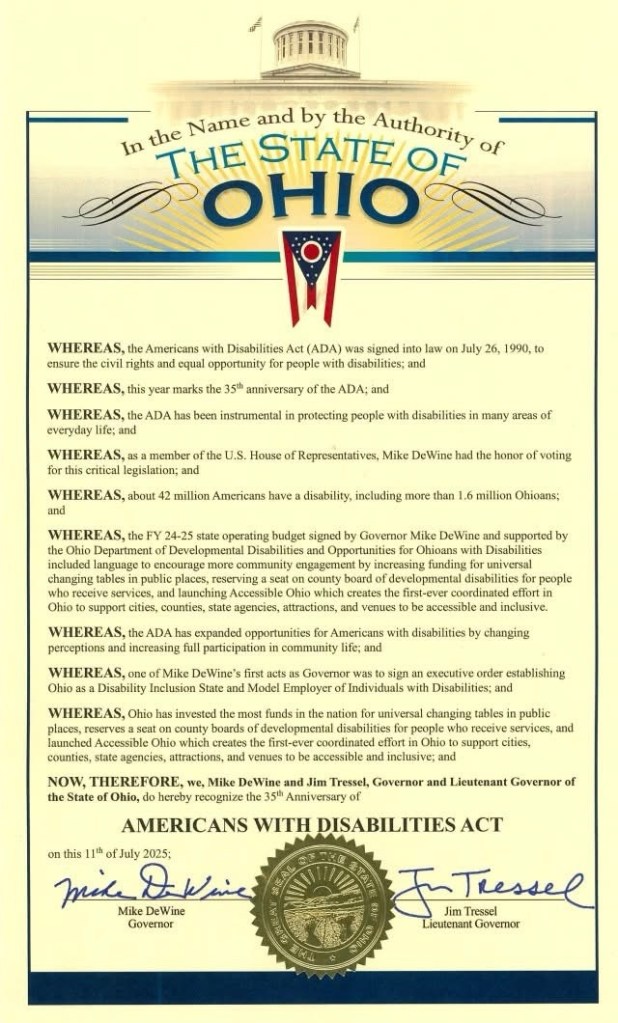
Ohio Pulse: What’s Happening in Ohio January 27th to February 1st, 2025?

Week of January 27th to February 1st, 2025

Every week Ohio Advocacy Heartbeat puts out a weekly what’s happening in Ohio and also we share one or two National Events to look forward to.

Upcoming Events for the week of January 27th to February 1st 2025. You can a calendar of events  on our main website OhioAdvocacyHeartbeat.com 

At the current moment there is a sign up for Ohio Developmental Disabilities Day at the statehouse and you can find it by clicking this link. Ohio DD Day is set for March 4th 2025 at the Ohio Statehouse Registration is required in advance for everyone including caregivers.

Monday January 27th 2025

Building an Inclusive 988 from 2-3pm register through this link

Tuesday January 28th, 2025 

Southwest Ohio Advocacy Group Meets in Cincinnati, Ohio. 6-8pm at 4623 Wesley Avenue Cincinnati, OH 45212, USA

Wednesday January 29th, 2025

Human Trafficking Prevention Advocacy Day at the Ohio Statehouse in Columbus, Ohio.

In recognition of Human Trafficking Prevention Month, the Collaborative to End Human Trafficking is hosting an advocacy day, along with its partners from across Ohio.
https://collabtoendht.networkforgood.com/events/78636-human-trafficking-prevention-statehouse-advocacy-day

Ohio Self Determination Association at We Thrive Together at 11 am For more information please go to https://wethrivetogether.org/upcoming-events/ 

Innovation in the Direct Care Workforce: Unlocking Success Through Peer Learning, Wednesday, Jan 29 · 2–3 PM

Please Register through this link.

Thursday January 30th, 2025

Pickaway County Provider Round Table 4-5pm at 200 E High Street Circleville, OH 43113, USA

Pickaway County is hosting a provider round table the topic is Compassion Fatigue. It is both in person and virtual. For questions or to receive the zoom link please contact aknotts@pickawaydd.org

Friday January 31st, 2025 

No known events 

Saturday February 1st 

No known events 

Why Braille is Beautiful by Dawn

Why Braille Is Beautiful


January is a big deal for a lot of reasons. It's the start of a new year, and an opportunity for new beginnings. It's technology month, and, self-care month. But, for the blind community, there's a couple very big reason why this month is so important. On January 4, 1809, a boy named Louis Braille was born. He lost his sight at the age of 3, after playing with one of his father's tools. He wanted to read and write just like every one else. But, back then, blind people were cut off from communicating, reading and writing. He attended The Royal School For Blind Youth in Paris France. There, he learned about a system called night writing, which was made up of dots and dashes that soldiers could feel and read on the battlefield. From that code, he invented a system of raised dots that is still used being used today. We use this system to read, write, and communicate. This year, in particular, marks an especially important milestone. This year, braille has been around for 200 years. Braille has opened up the world for the blind and visually impaired community. This is what makes braille so beautiful. Helen Keller, a deaf-blind disability rights activist, once said that we the blind are as indebted to Louis Braille as mankind is to Guttenberg for the printing press. In my view, there are no truer words! With that being said, here are some other reasons that braille is so beautiful.


1. It fosters independence
This for meeath is a huge one! Whether it's putting a label on your spice containers so you know which one is which, or putting braille on your microwave, it's a wonderful not to mention essential tool in the independent living toolbox. Plus, getting crucial documents you need in braille such as bank statements, is a blessing!

2. It helps us navigate
When you go in an elevator, the panel is brailled. It helps a blind student navigate their school building, and know which classroom they are entering. Per the ADA. all public buildings are required to have braille signage.

3. It increases your chance of getting employed
In the U.S. and around the world, the unemployment rate for blind and visually impaired is very high. However, braille can be a factor in whether someone gets employed or not. If a blind person knows braille, they're 90% more likely to get employed. This is because braille allows us to read and write with our sighted peers. This means that we can write emails and other correspondents related to work. Plus, if you have a refreshable braille display, your productivity will be even better.

4. Reading is more than just listening
While audiobooks are great, and can be an excellent way to access reading materials, you may be limited on what you can access. But, with braille, your world is significantly more open. With braille, you can access books on Bookshare, or through NLS.'s braille-on-demand program, which allows you to get up to 5 hardcopy braille books sent to your home per month. Also, if you have a refreshable braille display, books, newspapers, and magazines will be litterally at your fingertips!


I could go on and on about this topic, but, I want to hear from you! Why do you think braille is beautiful? How are you celebrating Braille Litteracy Month?


If you would like some braille resources, including how to get braille materials, The National Library Service For The Blind And Print Disabled has put together a page celebrating the 200th aniversary of the invention of braille. This page includes a list of NLS's braille litteracy initiatives, and ways to get access to braille materials. To find it, go to:


https://www.loc.gov/nls/braille-200/


Also, as a bonus, please enjoy this song by James Brown And The Cane Tips, and The National Federation Of The Blind, called Braille Is Beautiful.


https://youtu.be/-_AEO0WBKt4?si=_3IFe4ScId-qKa0m

Unite, Don't Fight: What Advocates Can And Should Do To Foster Unity By Dawn
Unite, Don't Fight: What Advocates Can And Should Do To Foster Unity


This world has a lot of problems, famine, war, the list is endless. There's also a lot of discourse, uncertainty, etc in this country and the world right now, especially politically, socially, and in advocacy. There's also a lot of issues in disability rights, and advocacy, both nationally and in this state. Such issues include but aren't limited to, digital accessibility, voting access, rideshare denials, and ending sub-minimum wage, just to name a few. This year, things will be even more intense, due to changing administrations, and in Ohio, this year it's budget season once again. While discourse and disagreement is good, there's a lot of in-fighting, partisanship, etc, which isn't good for anyone. As advocates, we need to unite, not fight, and, yes, foster some new relationships, and maintain relationships with current allies, whether policymakers, or other advocates.

This post is not meant to be political, nor endorse any particular person or party. I want this to be people and advocates together. Here are some things we can do as advocates.


1. Find some common ground we can work together on.
The National Federation Of The Blind, and the American Council Of The Blind, are 2 very different groups, and as such they have different advocacy styles, and advocate on different issues. However, they have found some common ground. A big example of this, is when they came together for a protest outside of Lyft's and Uber's headquarters in San Fransisco California. All too often, while there's common ground, we are not in agreement about how things should get done, etc. Let's look at big issues whether it's state issues, such as the direct care workforce crisis, or national issues, such as digital accessibility, and find ways we can work together, and unite.
I'm not saying that we can't work separately, but, if we can work together on various parts of an issue, or even an issue, it will foster a lot of unity.


2. Maintain Relationships With Current Allies in Policy and in the legislature
As advocates, we have a lot of allies, whether it's our family, friends, careworkers, or anyone else no matter what relationship they have with you. However, some of the most important allies we have, are the policymakers and our legislators. These are the people that can help us get things done, and make changes that can have a positive impact both nationally and at the state level for disability rights. Therefore, maintaining the rapport you have with or legislators is another way advocates can foster unity. These will be especially helpful once budget season starts.

3. Build Reltionships with new and incoming legislators
This year, there will be some new legislators in office in certain districts, both in Ohio and throughout the United States. For some, that may mean establishing new connections. This can be scary, and intimidating, on so many levels. But, we should at least try and reach out, and build a rapport with them, no matter what side of the aisile you both are on. You may be on the left, and sy may be on the right, but, that shouldn't matter. When it comes to advocacy, I check politics at the door. I'm not saying there isn't politics in advocacy, because there is. However, when it comes to disability rights, advocacy etc, we should be willing to work across political, social, and other lines. This is what I try to do. I try and overlook differences, and see where agrements can be reached. We're not going to agree with every one on every thing, and that's ok! In fact, it's what makes this country so great! But, if we can find common ground, and be civil when we disagree, we will get a lot more done. If you have new reps and senators in your districts, reach out and introduce yourself to them. Educate them on what life is like for people with disabilities nationally, in Ohio, and day-to-day. Educate them on the waiver systems in Ohio. Educate them on the issues that are important to you. Who knows, you may find more common ground than you thought you'd find, and you may find a new ally!

These are just a few ways we can foster unity. With budget season starting, and, various other changes that will be happening politically, it's more important now more than ever to come together. I'd like to hear from you. How else can we foster unity in the disability and advocacy community? How are you fostering unity and bringing people together? I want to hear your thoughts. Again, let me reitterate that this is not meant to be political post, nor is this post meant to endorse anyone. The goal of this post, is promote unity.

Seen & Heard: Advocacy Series Part 3

Advocacy Series Part 3. What can be done to support advocates

By: Dawn Bilpuch

We made it to the end! We talked about a lot of things, every thing from what advocacy is and what it means, to what people need to understand. Now, to wrap it up, we’re going to talk about what can be done to supmort advocates.
We love what we do. If we didn’t we wouldn’t be staying up til 3 AM. doing paperwork, or talking someone down and helping them through a crisis. This wasn’t meant to say bad things about advocacy. It was just meant to be educational and open people’s eyes. With that being said, let’s get into the things we can do to support advocates.

  1. Make accessibility a priority.
    Make your meetings, documents, etc accessible. That incbbudes Zoom captioning, converting documents into accessible formats, etc. Also, making our rules, laws and other websites we need to access them accessible. This includes federal rules and regulations and laws. Make info about getting accommodations accessible and easy to find. Put things in plain language. Put alt-text on graphics and photos. The list goes on and on. Also, offer virtual testimony. Some people including family members can’t always get out to the statehouse to testify, and still want to testify and submit written testimony. Virtual options give people that choice.
    In case you haven’t noticed, accessibility is one of those issues I could get on a soapbox about.
  2. Have an advocacy peer support network or group
    Advocacy can be very isolating. Not just because of the work, but, also, the nature of it, your disability(s) can play a part too, and where you live, and what you have to see and go through each day, along with many other factors, can play into this. As an advocate, you’re on your own, you have no backup, support etc. If things get to be too much or you need to vent, you’re on your own, and, if you have another advocate to go to, then that’s awesome! Creating a pwher support group or network for advocates both at a state and national level, will allow people to connect in whatever way is best for them, share what’s on their mind, bounce ideas off each other, and get and give support in a safe, nurturing, confidential space. People can then make friends and connections and talk outside the group if they want, and help each other.
  3. Be understanding and meet people where they’re at, give every one a seat at the table.
    Meeting people where they’re at, and helping them when they’re struggling and giving them grace when they fall on their face is crucial. Also, giving every one seats at the table. Also, give people plenty of opportunities to grow, as people and advocates! Take other new advocates under your wing. I had someone do that with and for me, and, let me tell you, that is one of the best things to ever happen to me. We’re alike in a lot of ways, and have connected in a lot of ways over various things. They are the same person whose life I saved. She took me under her wing, and, into her group that she ran, and, I’m so glad she did. She’s taught me and still teaching me about policy, rules, how to get accommodations, and so much more. I can’t thank her enough. We have become very close friends, and wouldn’t change it.
  4. Provide training
    One thing I think that’s lacking, is training on how to be an advocate, and surrounding all aspects of advocacy. Even if there’s training, it costs an arm and a leg, or you need college degrees. Not every one can afford or handle that. Offer plenty of free virtual and hybrid trainings, and, if they cost, offer ways for people to pay that can’t afford it, or find ways to reduce the cost if not eliminate it. Also, create some resources and have a resource hub for all things of this nature including places to go and get more spicific resources.
  5. Eliminate, reduce, or find ways to get around dues
    Not every one is made of money, and, if you’re disabled, that’s definitely the case. Because while benefits are great, you don’t make a lot to live on, especially with prices going up like they are. Some people can’t apply for benefits because of whatever circumstance. I think that if there’s organizations that have dues, they should find ways to help people that want to join, but can’t because of financial limitations. That could mean reducing or eliminating dues, offering assistance to people who can’t pay, offering a one-time payment for lifetime membership, or nixing dues altogether. The sky is the limit in some way on this one. Also, make sure that current members know that they can come to you if they have financial issues at any point.

What do you think needs to be done to support advocates? Are there any resources you know of? Whatever your thoughts, please feel free to share them.

Seen and Heard : Advocacy Series Part 2

Advocacy Series Part 2. What advocates wish people knew and understood

By: Dawn Bilpuch

Here’s part 2 of my advocacy series. This time, we’ll focus on what advocates wish people knew and understood about their profession.

We’ve all had this happen. There’s always one or some friends or family that don’t understand what you do, or why you do it, or both, or they don’t understand the life you live, etc.
In the last entry, we covered what advocacy and being an advocate means, and what it means to me, and asked what it means to you. While we may touch on some of the things covered in that part, we’ll also be covering some new areas.

Sadly, you’ll have people in your life as an advocate or other type of job especially public servants, that just do not understand what you do, why you have to do the things you do, and why you can’t just “leave work at the office” etc. What you have to do depends on the person and your situation. If you can distance yourself, that’s ideal. But, if not, things can get more complex. Also, while people may understand some things, they will never understand it fully. Because they aren’t doing the work, they aren’t living your life, etc. You’re the one doing the work, living the life, and every thing in between. I’ll be covering some things, but, I also want to hear from you.

We’re public servants, in some ways, similar to first responders. While we aren’t police, fire or EMS. and do not claim so be, we’re on-call 24/7 365 pretty much. Whether it’s for peer support, or dealing with unexpected crises in people’s lives, or any of a number of things. Yes, there’s still paperwork to do, emails to check and manage, the list goes on.
Plans will change on a dime. It has happened. Sometimes, it may mean missing family events, or meals etc. That means you have to be flexible with us too. Realize that our work is very demanding time-wise, and we just have to go with it.
The stuff we see, and, how it affects us, and what we have to do because of it.
This one’s a tough one. We see a huge amount of abuse, negelect, depravity, broken lives, and so forth. We see people that have either slipped through the cracks or are slipping. We see people that continue to slip through the cracks for numerous reasons. The system in their county is broken, every one passes blame, not enough resources to go around, the list goes on. It’s rampant, and it’s constant. Trust me when I tell you, that this stuff changes you. It changes your psyche. It drains you mentally and emotionally. If you have mental health chaklenges, it can exacerbate them. Or you’re at risk of developing them. Or, if you have your own past trauma and bd experiences, (which, sadly, is quite common,) things can get even more intense, and draining, among other things Sometimes, we just don’t talk about it because you wouldn’t get it, or it’s too painful, or whatever reason. Sometimes, we just need to talk to people to vent, cry boeak down, whatever we have to do.
Our day doesn’s end at 5 PM. Advocates don’t keep regular office hours. It’s near impossible. There’s sometimes there’s calls at 6 PM. or 9 PM. for instance, and things get quirky when other timezones are at play. Contrary to what people think, we can’t leave work at the office. Even when there’s no calls, you’re still keeping up with and managing emails, and, also, doing paperwork. Or sometimes helping people when their tech breaks down. The list is endless!

We’re not always extroverted. As I said before, we see a lot of crap. The inside of our heads looks like a crime scene sometimes. We are on calls, and the like all day long, around people. Plus, if you’re a caregiver as I am, things can get more intense. But, at the end of the day, the last thing I want to do, is talk on the phone with just anyone, or be around a bunch of people. It’s like what a tech or customer service rep feels like. They’re on the phone all day, dealing with the public. When they get done, the last thing they want to do is be on the phone 24/7 on off-hours. It’s the same thing. For me this is especially impoortant. If I talk to you it’s because either I need to vent, or I’m helping someone, or it’s a phone call I had to make when I had time, or, some other reason. Please respect that. When we say we don’t want to do something, go somewhere, etc, it’s not because we don’t love you. It’s because we’re peopled out, mentally, emotionally drained, and yes, physically too.
Taking time off isn’t as easy as it sounds. The planning that goes into it for us advocates is intense. Even with our planning, we may not get that day off.
It’s a weird profession. There’s people that get paid for it, and, others who do it as a volunteer thing. Then there’s people that would love to get paid for at least some of what they do. Do I want volunteer work? Yes. But, I’d also love to get paid for what I do also, and make a living from it. I’d even accept barter-and-trade, and I have in the past.
Advocacy is a huge part of your being and identity, and who you are as a person. If we didn’t love what we did, we wouldn’t be doing it.

There’s a lot of other things that I want people to understand, but, I have a hard time finding words for them. I think that’s one other thing I want so to understand. Is that sometimes, as advocates, we want to talk or need to talk. But, sometimes, we just can’t put what we want to say to words. Sometimes we can write it better, and sometimes, we can say it better and sometimes it’s both. Other times, we have to find other ways to say what we want to say, such as sharing songs with people . So, with that being said, what would you want people to understand about being an advocate and advocacy? I’d love to hear your thoughts! Stay tuned for the last entry in this series, which will cover things that can be done to help advocates